
Are B2B Commerce Platforms Solving Tomorrow's Problems?
%201.png)
Are B2B Commerce Platforms Solving Tomorrow's Problems?
When we talk to B2B enterprise leaders today, the frustration is almost always the same. Organizations are trying to run modern, multi-channel operations on technology foundations that were built for a completely different era.
B2B commerce is changing faster than most businesses anticipated. The way organizations buy and sell has become intensely digital, deeply connected, and exponentially complex. Buyers now expect the frictionless speed of consumer commerce, while businesses are simultaneously wrestling with intricate catalogs, negotiated pricing tiers, multi-market expansions, legacy ERP dependencies, and supply-chain constraints.
At the same time, commerce technology is racing forward. Platforms are expanding far beyond basic storefronts, composable architectures have challenged traditional monoliths, and AI is beginning to influence everything from discovery and procurement to fulfillment and operations.
Yet, watching this unfold across the industry brings us back to a fundamental question: Are today's B2B commerce platforms actually solving tomorrow's problems, or are we still building for a version of commerce that is already disappearing?
1. Commerce Is Moving Faster Than Our Legacy Playbooks
For a long time, the commerce platform was viewed simply as the place where a transaction happened. A customer found a product, added it to a cart, checked out, and the system processed the order.
In our experience, B2B commerce has never really been that simple. The transaction is just a single dot in a massive operational journey:
- Product information originates in one system.
- Pricing rules flow from another.
- Inventory, orders, and fulfillment span disparate ERPs, warehouses, and logistics networks.
Now layer digital buying portals, self-service hierarchies, mobile experiences, real-time personalization, and AI decision-making onto that environment. A commerce platform can no longer operate as an isolated island. It has become a core component of a much larger commerce operating ecosystem.
That reality completely changes the strategic question businesses should be asking. It is no longer simply: “Which platform has the longest feature list today?” Instead, executive leadership must ask: “Which technology foundation can continuously adapt as the way we do business changes?”
2. The Hidden Traps of Traditional and Composable Approaches
While industry trends push aggressively toward agility, enterprises attempting to implement these modern architectures frequently run into severe operational walls. Over the years, we have seen companies fall into three distinct traps:
- The Prohibitive TCO of Modular Flexibility: True modular adaptability sounds great in theory, but executing it is immensely expensive. Shifting from a legacy suite to a hyper-flexible architecture often triggers a cost explosion in ongoing custom maintenance, specialized engineering talent, and redundant third-party contracts.
- Integration Spaghetti and Vendor Finger-Pointing: In a standard multi-vendor composable setup, more components inevitably mean more integration points. When a pricing pipeline or checkout flow breaks, the search vendor blames the PIM, the PIM blames the OMS, and the enterprise is left stranded in a web of vendor finger-pointing.
- The Data Readiness Mirage: Everyone wants to leverage AI to transform operations from procurement to post-sale. Yet, most enterprises are sitting on fragmented data silos, inconsistent taxonomies, and messy catalog structures. Building advanced AI on top of unmanaged data leads straight to failure.
Enterprise readiness cannot be measured by theoretical modularity or raw scale alone. It requires an architecture that evolves without turning every minor business pivot into an expensive, high-risk engineering marathon.
3. From Systems of Transaction to Systems of Orchestration
AI is going to do much more for commerce than just automate product descriptions or polish search results. Its true impact spans the entire operational cycle
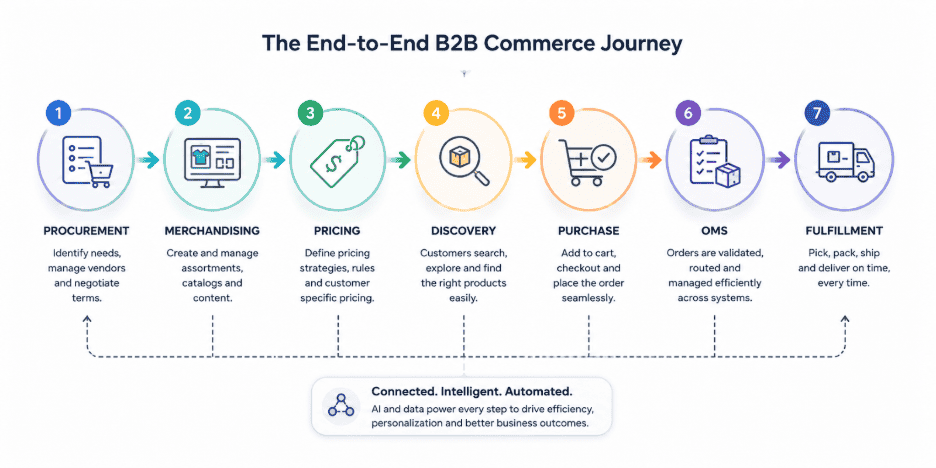
In B2B environments, product discovery is where intent turns directly into revenue. When enhanced by AI-driven search, the discovery phase moves past rigid keyword matching to intuitively understand complex contextual queries, substitute parts, and tiered contract pricing on the fly.
If AI is to make recommendations and take action reliably across these stages, the commerce platform must provide more than raw transaction processing. It must supply the data, context, connectivity, and orchestration required for those decisions to happen without friction. This represents a profound shift: moving away from commerce platforms as static systems of transaction and toward commerce platforms as dynamic systems of orchestration.
4. What It Takes to Actually Build for Tomorrow's Commerce
When we look at these systemic industry hurdles—and when we consider what we spent years engineering into Composed. Commerce to solve them—it becomes clear that theoretical composability isn't enough. Moving past these friction points requires a deliberate architectural response:
- Eliminating Integration Spaghetti with Unified Orchestration: Enterprises should not have to act as general contractors gluing together a fragile web of APIs. A modern architecture must package the core experience layer alongside a unified orchestration framework that keeps vendor accountability under one roof and drastically slashes time-to-market.
- Moving Beyond Keywords to Semantic Discovery (SERA GPT): B2B search cannot rely on primitive matching anymore. Discovery layers must leverage advanced AI such as the semantic capabilities we built into SERA GPT to natively interpret complex catalog logic, technical specifications, and tiered contract pricing on the fly, turning intent directly into revenue.
- Guaranteeing Performance at Scale (N7 Nitrogen): High intelligence is useless if the underlying infrastructure lags. Architectures require dedicated acceleration layers like N7 Nitrogen to eliminate latency, optimize heavy media assets, and supercharge search engine and AI crawler indexing so real-time execution never bogs down the buyer.
- Curing Data Debt Before AI Deployment: You cannot build autonomous AI on top of messy catalogs and fragmented data silos. Grounded in decades of Master Data Management (MDM) expertise, true operational readiness requires cleansing and structuring product catalogs, customer hierarchies, and pricing rules at the database level first to eliminate hallucinations entirely.
By embedding these realities directly into our own work, we’ve found that the answer isn't giving enterprises more isolated tools to assemble—it's providing a cohesive system of orchestration built for the realities of modern commerce.
5. The Next Five Years: What Should Enterprises Invest In?
Predicting the exact state of commerce five years from now is a challenge, but the trajectory is clear. Enterprises must shift their investment criteria away from superficial feature checklists and toward resilient foundations:
- Architectures that Orchestrate, Not Just Connect: Systems must actively reduce integration complexity rather than multiplying it across vendors.
- Pragmatic Composability: Agility must be paired with pre-packaged governance to prevent runaway total cost of ownership.
- Pristine Data Foundations & High-Performance Delivery: Data quality must always precede AI deployment, backed by robust execution layers that handle semantic discovery and high-speed delivery seamlessly.
The biggest risk for modern enterprises is not choosing the wrong feature set; it is choosing a platform architecture that makes the business inherently slower to change.
So, are B2B commerce platforms solving tomorrow's problems? Right now, many are not—they are simply digitizing yesterday’s friction. But as the industry shifts its focus toward true architectural orchestration, data readiness, and intelligent discovery, the path forward becomes clear. The real test is still ahead, and the organizations that win will be those built on foundations flexible enough to solve the problems we haven't even encountered yet.
Faq
Insights
Looking for resources, tools, tips and industry news? Stay ahead of the curve with quick access to thought leadership and expert insights on digital transformation.

Enterprise Commerce Didn’t Get Simpler After Composable - It Just Shifted the Complexity
Composable commerce solved many limitations of traditional platforms, but it also introduced new operational challenges across integrations, governance, and team coordination. As enterprises adopt headless architectures, ecommerce ERP integration, and AI-powered commerce, long-term success now depends more on operational maturity than technology alone.
Enterprise Commerce Didn’t Get Simpler After Composable - It Just Shifted the Complexity
Composable commerce solved many limitations of traditional platforms, but it also introduced new operational challenges across integrations, governance, and team coordination. As enterprises adopt headless architectures, ecommerce ERP integration, and AI-powered commerce, long-term success now depends more on operational maturity than technology alone.
Enterprise Commerce Didn’t Get Simpler After Composable - It Just Shifted the Complexity
Composable commerce solved many limitations of traditional platforms, but it also introduced new operational challenges across integrations, governance, and team coordination. As enterprises adopt headless architectures, ecommerce ERP integration, and AI-powered commerce, long-term success now depends more on operational maturity than technology alone.
Why Product Data Is Becoming the Backbone of Digital Commerce
Product data has become the foundation of modern digital commerce, directly impacting discoverability, conversion, and customer experience. This article explains why poor data silently kills performance and how structured product data, powered by PIM and governance, enables scalable, AI-driven commerce growth.
Why Product Data Is Becoming the Backbone of Digital Commerce
Product data has become the foundation of modern digital commerce, directly impacting discoverability, conversion, and customer experience. This article explains why poor data silently kills performance and how structured product data, powered by PIM and governance, enables scalable, AI-driven commerce growth.
Why Product Data Is Becoming the Backbone of Digital Commerce
Product data has become the foundation of modern digital commerce, directly impacting discoverability, conversion, and customer experience. This article explains why poor data silently kills performance and how structured product data, powered by PIM and governance, enables scalable, AI-driven commerce growth.