
Data Governance Maturity Model: A Guide to Assessing and Improving Data Governance
Data Governance Maturity Model: A Roadmap to Building Trusted Enterprise Data
In today’s data-driven business environment, organizations cannot afford to operate with fragmented, inconsistent, and unmanaged information. As enterprises generate data across applications, cloud platforms, analytics systems, and digital channels, the ability to govern that data effectively has become a strategic priority.
A Data Governance Maturity Model provides organizations with a structured roadmap to understand their current capabilities, identify gaps, and define the steps required to build a scalable, compliant, and trusted data environment.
At Nvizion Solutions, we help enterprises move from siloed data practices to governed, AI-ready data ecosystems. Our approach focuses on creating the right balance between people, processes, technology, and governance frameworks to help organizations unlock long-term value from their data.
Understanding the Data Governance Maturity Journey
Data governance maturity is not achieved overnight. Organizations typically progress through multiple stages, evolving from limited awareness and reactive processes to a proactive, business-driven governance model.
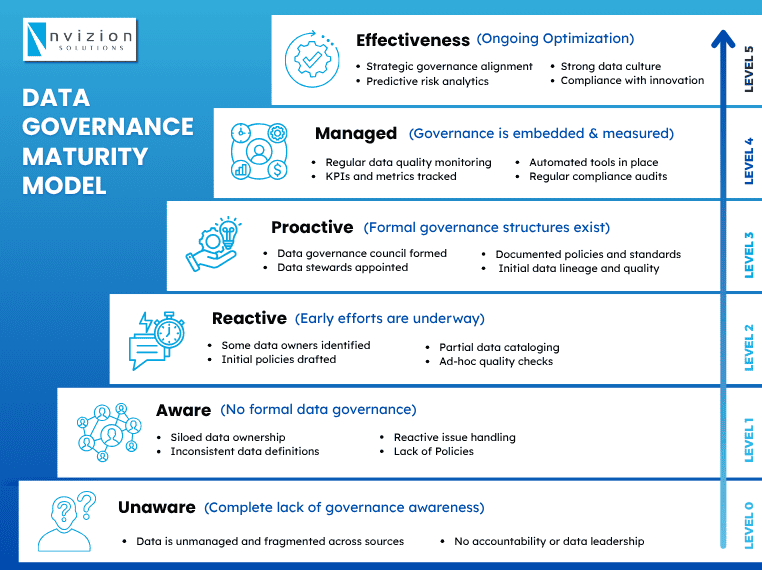
At the earliest stage, known as the Unaware stage, organizations have limited understanding of the importance of data governance. Data remains scattered across systems, ownership is unclear, and there are no defined policies or accountability structures in place. Data issues are often addressed only when they impact business operations.
As organizations enter the Aware stage, they begin recognizing the need for better data management. However, governance efforts are still fragmented. Different departments may maintain their own definitions, processes, and standards, resulting in inconsistent information across the enterprise.
The Reactive stage represents the beginning of structured governance efforts. Organizations start identifying data owners, documenting initial policies, and introducing basic data quality checks. However, these activities are often driven by immediate business needs rather than a comprehensive governance strategy.
At the Proactive stage, governance begins to become more formalized. Organizations establish governance councils, define stewardship responsibilities, introduce data standards, and start implementing capabilities such as data lineage tracking and quality management. Data governance shifts from problem-solving after issues occur to preventing issues before they impact the business.
The Managed stage is where governance becomes embedded into daily operations. Organizations actively monitor data quality, measure performance through governance KPIs, automate governance processes, and conduct regular compliance assessments. Data ownership and accountability become part of the organization’s operating model.
The highest level of maturity is the Effective stage, where data governance is fully aligned with business strategy. Organizations use advanced analytics, automation, and predictive capabilities to identify risks, improve decision-making, and continuously optimize their data environment. Governance becomes a business enabler rather than a compliance exercise.
Building a Strong Data Governance Framework
Moving toward higher governance maturity requires a structured approach that aligns business objectives with data strategy.
The journey begins with assessment and discovery, where organizations evaluate their current maturity across areas such as data ownership, policies, processes, architecture, and organizational culture.
Once the current state is understood, organizations can define their target state by aligning governance goals with business priorities and identifying the capabilities required to achieve them.
The next step involves designing a governance framework that establishes clear roles, responsibilities, standards, workflows, and technology requirements. This ensures that data ownership is clearly defined and governance becomes part of everyday business operations.
Implementation should happen in phases, focusing on quick wins while gradually expanding governance capabilities. Effective change management, training, and business adoption are critical to ensuring that governance practices are sustained across the organization.
Continuous monitoring and improvement complete the journey. By establishing metrics, conducting regular audits, and refining processes, organizations can ensure that governance evolves alongside changing business requirements.
Key Areas That Define Governance Maturity
A comprehensive governance maturity assessment evaluates multiple dimensions that influence an organization’s ability to manage data effectively.
These include data strategy and vision, organizational roles and stewardship, policies and standards, data quality management, architecture and integration capabilities, metadata management, data cataloging, privacy and compliance, security practices, data literacy, technology enablement, and continuous improvement processes.
Together, these capabilities determine how effectively an organization can create trusted, accessible, and valuable data assets.
Why Data Governance Maturity Matters
Organizations with mature data governance capabilities gain more than improved compliance. They create a foundation for faster decision-making, stronger analytics, improved AI outcomes, and greater operational efficiency.
Trusted data enables business teams to confidently use insights, automate processes, and innovate without being limited by inconsistent or unreliable information.
As AI adoption accelerates, governance maturity becomes even more critical. AI systems depend on accurate, well-managed, and context-rich data. Without strong governance, organizations risk scaling poor-quality data and unreliable outcomes.
How Nvizion Helps Organizations Advance Their Governance Maturity
At Nvizion Solutions, we help enterprises assess their current governance maturity, define future-state capabilities, and implement practical frameworks that align with business goals.
Our approach combines governance strategy, data quality improvement, stewardship models, metadata management, compliance frameworks, and technology enablement to create sustainable data ecosystems.
Whether an organization is beginning its governance journey or looking to optimize existing capabilities, Nvizion provides the expertise and roadmap needed to build trusted, secure, and AI-ready data environments.
Data governance maturity is not just about controlling data.
It is about creating the confidence to use data as a strategic asset for growth, innovation, and better business outcomes.
Faq
Insights
Looking for resources, tools, tips and industry news? Stay ahead of the curve with quick access to thought leadership and expert insights on digital transformation.