
From Data Cleansing to Continuous Data Quality: Building a Proactive Quality Framework
Traditional data cleansing treats quality as a project with a defined end date. Teams identify defects, clean records, reload tables and consider the job complete. However, this only provides a temporary fix. As new data enters the system and existing records become outdated, quality begins to deteriorate again. Dashboards become unreliable, AI models produce weaker results, compliance risks increase and confidence in business data declines.
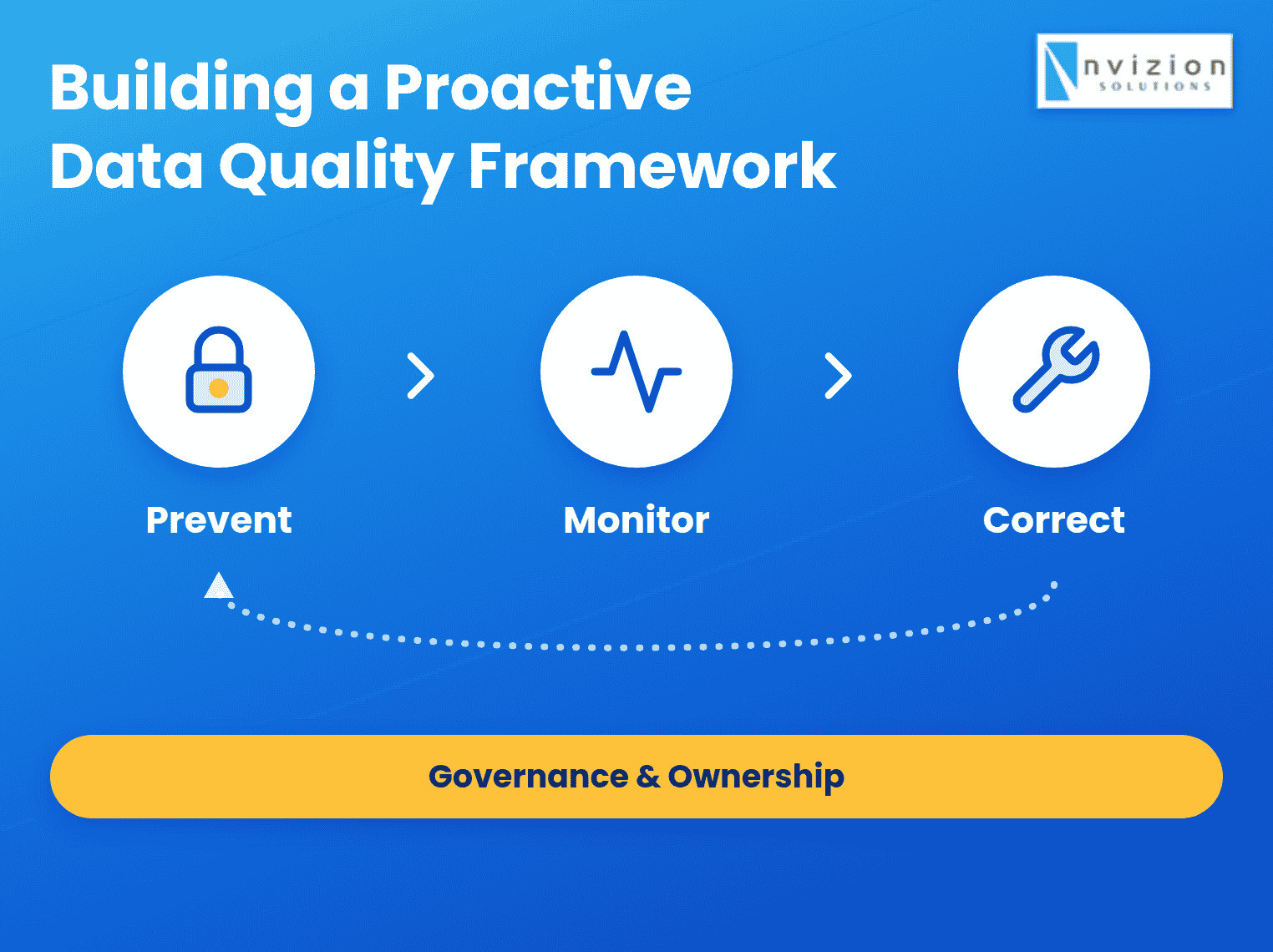
Organizations are moving beyond reactive cleanup towards continuous data quality. This approach embeds prevention, monitoring and correction throughout the data lifecycle. Instead of asking whether data has been cleaned, businesses focus on whether it remains fit for its intended purpose. That means ensuring accuracy, completeness, consistency, timeliness, uniqueness and relevance based on the needs of the processes that depend on it.
Why Cleansing Alone Falls Short
Data cleansing resolves known defects at a particular point in time, but it does not address the underlying causes. Free-text fields, inconsistent source systems, schema changes, delayed data feeds and evolving business processes continue to introduce errors.
Often, these problems surface only after a stakeholder notices an incorrect dashboard or an AI model produces questionable results. By then, the impact may already have reached business operations. Teams are forced to repeat the same manual corrections, increasing costs while confidence in the data continues to decline.
The economics reinforce the need for a different approach. The widely cited 1:10:100 rule suggests that preventing a data defect at its source costs significantly less than correcting it within a system or addressing its consequences after it affects a business decision, customer or regulator. Although the exact costs vary, the principle remains the same: early prevention is more efficient than repeated remediation.
Reactive data quality work also diverts resources from innovation and strategic priorities. A more sustainable approach treats quality as an ongoing capability supported by clear ownership, measurable standards and automated controls.
The Framework: Prevent, Monitor and Correct
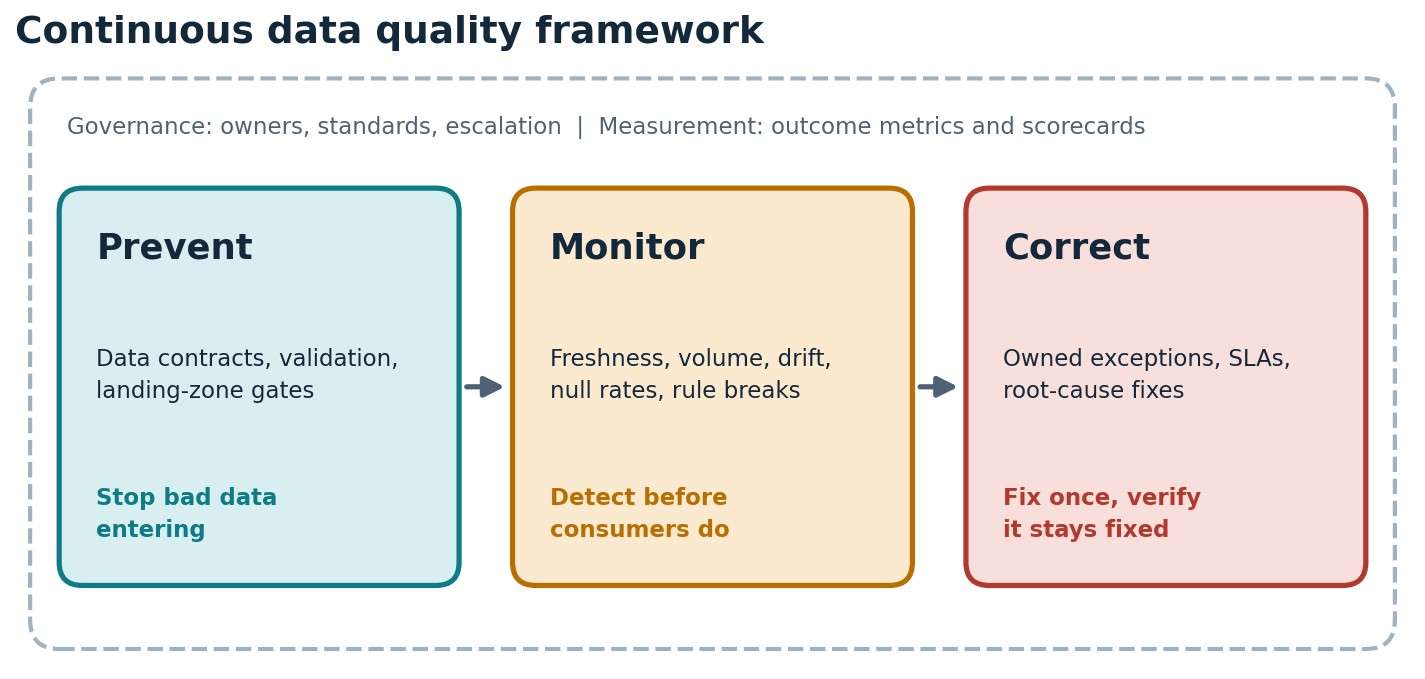
A proactive data quality framework combines three core functions: prevention, continuous monitoring and targeted correction. Governance and accountability support each function, while lessons from recurring issues strengthen future controls.
1. Prevent Defects at the Source
The most effective way to manage data quality is to prevent errors before they spread across systems. This means validating data when it is created, entered or ingested rather than waiting for downstream processes to identify problems.
Organizations can introduce required-field checks, format and range validations, referential integrity rules and standardized value lists across entry systems and data pipelines. Data contracts between producers and consumers can establish clear expectations for structure, content and delivery.
Pipeline controls should also validate row counts, data freshness and required columns at ingestion. If a critical threshold is breached, downstream processing can be paused until the issue is resolved.
The objective is to make quality part of data creation and movement, reducing the need for repeated cleanup later.
2. Monitor Data Quality Continuously
Periodic audits cannot keep pace with modern data environments, particularly when pipelines operate frequently or support time-sensitive decisions. Continuous monitoring helps teams identify issues before they affect downstream consumers.
Key monitoring signals include:
Freshness: Did the data arrive within the expected timeframe?
Volume: Are record counts within expected limits?
Distribution: Have value patterns changed unexpectedly?
Completeness: Are critical fields missing more frequently?
Business rules: Do records violate established business logic?
Combining predefined validation tests with anomaly detection helps identify both known failure patterns and unexpected changes.
Data observability adds further context by connecting quality issues to data lineage, dependencies and downstream impact. This helps teams identify the source of a problem, notify the appropriate owner and respond before business users are affected.
3. Correct Issues and Prevent Recurrence
Detecting a defect is only the beginning. Organizations need a defined process for investigating, assigning and resolving data quality issues.
Each issue should have a designated owner, a resolution priority and a service-level agreement (SLA). Where possible, teams should correct the underlying cause rather than repeatedly modifying individual records.
For example, recurring invalid values may indicate a problem with a source-system interface or an entry process. Fixing that mechanism is more effective than correcting the same values every week.
Once a fix is implemented, teams should verify that the issue does not recur in subsequent data cycles. Automation and AI-assisted remediation can accelerate this process, provided that appropriate validation, human oversight and audit trails remain in place.
4. Establish Governance and Accountability
Data quality cannot be sustained by technical teams alone. Business stakeholders understand how data is used, while technical teams manage the systems and pipelines through which it moves.
Each critical data domain should have a business owner responsible for defining quality expectations and a technical owner responsible for implementing and maintaining the relevant controls.
Standards should reflect actual business requirements rather than generic checklists. A customer record used for regulatory reporting may require stricter validation than a field used for internal exploratory analysis.
Clear ownership, escalation paths and shared performance metrics ensure that data quality issues receive attention and that controls remain effective over time.
Measuring What Matters
Metrics such as the number of records cleaned or tickets closed can indicate activity, but they do not necessarily demonstrate improvement. A team that repeatedly fixes the same defect may appear productive while the underlying problem remains unresolved.
A continuous data quality framework should focus on outcomes, particularly reductions in recurring defects, manual intervention and the time required to detect and resolve issues.
Critical-rule pass rate: This measures the percentage of records that meet all critical validation rules. Organizations might target a pass rate of 99% or higher for critical data elements, with daily reviews.
Defect recurrence rate: This tracks the percentage of resolved defects that reappear within 90 days. A target below 5%, with a consistent downward trend, can help indicate whether corrective actions are effective. Review this metric monthly.
Time to detect: This measures the median time between a defect being introduced and an alert being generated. For high-priority pipelines, an illustrative target is less than one hour. Review performance weekly.
Time to resolve: This tracks the median time between an alert and a verified fix. Resolution targets should reflect business impact and agreed service-level agreements. For example, critical issues might require resolution within four hours, while lower-priority issues could have a three-day SLA.
Freshness SLA compliance: This measures the percentage of scheduled data loads completed on time. Organizations might target 98% or higher compliance, with daily monitoring.
Manual-fix ratio: This tracks the proportion of all data corrections performed manually. Reducing this ratio by 25% per quarter can be an illustrative improvement goal, provided the baseline and business context support it.
Business-impact incidents: This measures incidents such as delayed financial reporting, compliance exceptions or customer-facing errors caused by poor data quality. The objective should be to prevent the same root cause from recurring.
These targets are illustrative, not universal benchmarks. Organizations should adapt them to their data requirements, risk levels and operational priorities.
To make these metrics actionable, establish a baseline before setting targets. A two-to-four-week measurement period can help teams understand current performance and identify realistic improvement opportunities.
Prioritize critical data elements that affect revenue, regulatory obligations or important business decisions. Assign an owner to every metric and define clear escalation triggers. For example, two consecutive failures against a critical rule could initiate a root-cause investigation.
Finally, use a shared scorecard with consistent definitions for business and technical teams. Focus on recurrence rather than simply counting defects. A sustained decline in recurring issues is a stronger indicator of effective prevention than an increase in cleanup activity.
A Practical Example: Lead-to-Order Data Quality
Consider an organization experiencing recurring problems across its customer relationship management (CRM), order management and finance systems. Sales leaders report duplicate customer accounts, missing regional information and orders that fail to synchronize with finance.
A continuous data quality framework can address these problems systematically.
Step 1: Profile the data. Assess duplicate records, missing fields and invalid values across CRM, order and finance datasets. An initial assessment might reveal duplicate accounts at 8% and missing regional information at 12%.
Step 2: Assign ownership. Sales Operations owns the business rules and customer data requirements, while data engineering manages the integration pipelines.
Step 3: Define quality rules. Require a valid region, validate email formats and establish a reliable method for identifying unique customer accounts using tax identifiers where appropriate.
Step 4: Prevent errors. Replace free-text regional entries with standardized dropdown values, introduce duplicate checks during account creation and establish a data contract with finance.
Step 5: Monitor data flows. Add freshness, volume and validation checks at each integration point. Generate an alert if order synchronization falls more than 30 minutes behind the expected schedule.
Step 6: Resolve root causes. Route exceptions to the responsible owner with a defined two-day SLA. Investigate recurring failures and correct them at the source.
Step 7: Measure and expand. Compare results against the baseline. For example, duplicate accounts might decline from 8% to 1.5%. Once the approach proves effective, apply the same framework to other critical data flows.
All figures in this example are illustrative, not industry benchmarks.
Building a Continuous Data Quality Framework
Organizations do not need to transform every data process at once. A focused implementation can demonstrate value and establish a repeatable approach.
Start With a High-Impact Data Flow
Choose a process where poor data quality already creates measurable costs or operational risk. Lead-to-order processing, revenue recognition and customer master data are potential starting points.
Profile the data, map dependencies, identify owners and define rules based on the process's requirements. Introduce preventive controls and monitoring, then measure whether defects, manual corrections and resolution times improve.
Once the process stabilizes, extend the framework to additional data flows.
Use Technology to Strengthen the Process
Data catalogs, lineage tools, observability platforms and data quality engines can make quality management more scalable. However, technology alone cannot compensate for unclear ownership or poorly defined standards.
AI and machine learning can strengthen the framework through anomaly detection, adaptive validation and AI-assisted remediation. In mature environments, these capabilities can also support self-healing pipelines that detect and resolve specific failures automatically.
The most effective implementations build these capabilities on a foundation of reliable validation rules, governance and accountability.
Make Quality Part of Everyday Operations
Sustained improvement requires a shift in how teams approach data. Instead of celebrating large cleanup exercises, organizations should recognize reductions in recurring defects and manual rework.
Quality checks should become part of development, testing and release processes, ensuring that new pipelines include appropriate validation from the outset. Business and technical teams should also review quality performance regularly and use recurring issues to improve upstream processes.
Over time, continuous quality becomes an established operating discipline rather than an occasional remediation initiative.
The Business Value of Continuous Data Quality
Moving from periodic cleansing to continuous data quality helps organizations reduce recurring rework, improve confidence in business reporting, strengthen compliance and create a more dependable foundation for analytics and AI.
Reliable data also supports better decision-making across departments because business users can spend less time questioning records and reconciling conflicting information.
The goal is not simply to maintain a clean database. It is to ensure that data remains fit for purpose as business needs, systems and processes evolve.
Achieving this requires more than adopting new tools. It requires organizations to rethink how data is created, validated, moved, monitored and owned. By embedding prevention, monitoring and correction into the data lifecycle, businesses can move away from periodically restoring quality and towards continuously maintaining it.
Faq
Insights
Looking for resources, tools, tips and industry news? Stay ahead of the curve with quick access to thought leadership and expert insights on digital transformation.