
Snowflake vs Databricks: What Data & AI Leaders Should Choose and Why
%201.png)
In This Article
- Snowflake vs Databricks: Which Cloud Data Platform Is Right for Your Enterprise?
- Snowflake vs Databricks: Understanding the Core Difference
- Databricks: Built for Data Engineering and AI
- When Does Snowflake Make Sense?
- When Does Databricks Make Sense?
- AI and Machine Learning Capabilities
- Cost and Operational Considerations
- Industry Perspective
- Retail
- Manufacturing
- Pharmaceutical and Life Sciences
- The Right Question to Ask
- Conclusion
- How Nvizion Helps
Snowflake vs Databricks: Which Cloud Data Platform Is Right for Your Enterprise?
In today's data-driven enterprises, choosing the right cloud data platform is no longer just a technology decision.
It is a business, data, and AI strategy decision.
As organizations modernize analytics, adopt cloud-native architectures, and invest in artificial intelligence, one question continues to surface in executive discussions.
Should we choose Snowflake or Databricks?
For CIOs, CDOs, Heads of Data, Analytics Leaders, and Enterprise Architects, the answer depends less on vendor comparisons and more on business objectives, data maturity, and long-term AI strategy.
Rather than focusing on vendor hype, this guide explores the practical differences between Snowflake and Databricks, helping organizations choose the right platform for analytics, AI, and enterprise data modernization.
Snowflake vs Databricks: Understanding the Core Difference
Both Snowflake and Databricks are modern, cloud-native data platforms trusted by global enterprises.
However, they were built to solve different challenges.
Snowflake is designed primarily as a cloud data warehouse that simplifies analytics, reporting, and business intelligence for structured enterprise data.
Databricks is built as a Lakehouse platform that unifies data engineering, data science, machine learning, and AI on a single architecture.
Understanding this distinction is the first step toward selecting the right platform.
Snowflake: Simplicity for Modern Analytics
Snowflake focuses on making enterprise analytics simple.
Its architecture abstracts infrastructure complexity, allowing business analysts, BI teams, and data professionals to focus on generating insights rather than managing compute resources.
Organizations using Snowflake typically benefit from SQL-first analytics, rapid dashboard development, governed reporting, and scalable business intelligence without extensive platform administration.
For companies whose primary objective is enterprise reporting and self-service analytics, Snowflake offers a highly productive environment
Architecture Comparison
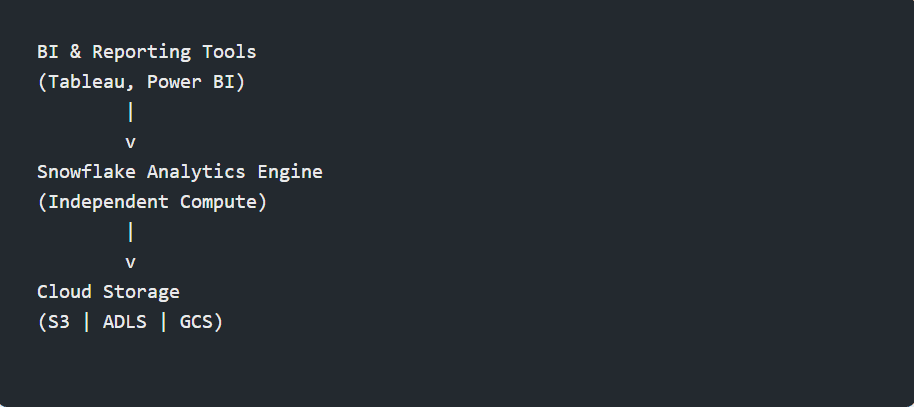
Databricks Architecture
.png)
Data Types & Workload Fit
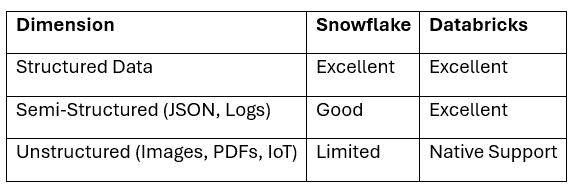
Key takeaway: As data variety increases, Databricks offers greater flexibility.
Databricks: Built for Data Engineering and AI
Databricks takes a different approach.
Built on Apache Spark and an open Lakehouse architecture, it is designed for organizations managing massive volumes of structured, semi-structured, and unstructured data.
Its strength lies in integrating data engineering, advanced analytics, machine learning, and generative AI within a unified platform.
Organizations adopting Databricks typically use it to process large-scale data pipelines, develop AI models, manage streaming data, and support enterprise-wide AI initiatives.
For businesses investing heavily in AI transformation, Databricks provides significantly greater flexibility.
When Does Snowflake Make Sense?
Snowflake is often the preferred choice when organizations are focused on business intelligence and governed enterprise analytics.
It performs exceptionally well for finance reporting, sales analytics, operational dashboards, regulatory reporting, and SQL-driven data exploration.
Organizations with structured enterprise data sourced from ERP, CRM, finance, and operational systems often find Snowflake to be a straightforward and scalable solution for analytics.
Its ease of use also reduces the learning curve for business users.
When Does Databricks Make Sense?
Databricks becomes the stronger choice when organizations require advanced data engineering and AI capabilities.
It is particularly effective for processing massive datasets, building machine learning models, supporting generative AI initiatives, managing streaming data, and analyzing semi-structured or unstructured information.
Companies working with IoT data, clickstream analytics, recommendation engines, predictive maintenance, fraud detection, or large-scale AI workloads generally benefit more from Databricks.
Its architecture is designed to support modern data science from experimentation through production.
AI and Machine Learning Capabilities
Artificial Intelligence is increasingly influencing enterprise platform decisions.
This is where Databricks currently holds a significant advantage.
Databricks was designed to support the complete AI lifecycle, including data preparation, feature engineering, model development, experimentation, deployment, monitoring, and governance.
Its integrated support for machine learning and generative AI makes it particularly attractive for AI-first organizations.
Snowflake has expanded its AI capabilities considerably and continues to introduce new AI features.
However, its primary strength remains governed analytics and cloud data warehousing rather than end-to-end AI development.
Organizations planning significant investments in machine learning or GenAI often view Databricks as the more comprehensive AI platform.
Cost and Operational Considerations
Cost is another important factor when comparing Snowflake and Databricks.
Snowflake generally provides predictable pricing for business intelligence and reporting workloads.
However, organizations performing large-scale transformations or computationally intensive processing may experience higher compute costs.
Databricks is often more cost-efficient for extensive data engineering and AI workloads but typically requires stronger governance, workload optimization, and platform expertise to maximize efficiency.
The right choice depends on workload characteristics rather than pricing alone.
Industry Perspective
Retail
Retail organizations manage enormous volumes of transactional data, customer interactions, product catalogs, and omnichannel experiences.
Snowflake is well suited for sales reporting, inventory analytics, customer insights, pricing analysis, and executive dashboards where structured data is the primary focus.
Databricks becomes increasingly valuable for AI-powered demand forecasting, recommendation engines, customer personalization, clickstream analysis, dynamic pricing, and real-time customer behavior analytics.
Many leading retailers combine both platforms, using Databricks for AI and advanced analytics while relying on Snowflake for governed reporting and enterprise dashboards.
Manufacturing
Manufacturing organizations are accelerating Industry 4.0 initiatives through connected factories, IoT sensors, predictive maintenance, and digital twins.
Snowflake supports enterprise reporting across ERP, MES, supply chain, production, and finance systems, providing trusted analytics for operational decision-making.
Databricks excels at processing sensor data, manufacturing telemetry, predictive maintenance models, quality analytics, and large-scale industrial AI applications.
Many manufacturers use Databricks as their engineering and AI platform while leveraging Snowflake for business reporting and governance.
Pharmaceutical and Life Sciences
Pharmaceutical organizations operate in highly regulated environments where compliance, governance, and scientific innovation must coexist.
Snowflake provides a strong foundation for commercial reporting, regulatory analytics, finance, sales performance, and compliance-driven reporting.
Databricks supports clinical research, genomics, drug discovery, AI-driven diagnostics, real-world evidence analytics, and scientific computing involving large and complex datasets.
A combined architecture often allows pharmaceutical organizations to innovate while maintaining strict governance requirements.
The Right Question to Ask
Organizations often ask whether they should choose Snowflake or Databricks.
The better question is different.
What business problems are we solving today, and where is our data and AI strategy heading over the next five years?
For many enterprises, the answer is not one platform or the other.
It is both.
Snowflake provides trusted, governed analytics for business users, while Databricks powers advanced engineering, data science, machine learning, and AI initiatives.
Rather than viewing them as competing technologies, leading organizations increasingly see them as complementary components of a modern enterprise data architecture.
Conclusion
Snowflake and Databricks each play an important role in modern data ecosystems.
Snowflake simplifies enterprise analytics, reporting, and business intelligence through a highly governed cloud data warehouse.
Databricks enables large-scale data engineering, advanced analytics, machine learning, and AI through an open Lakehouse architecture.
The right platform depends on your organization's business priorities, data complexity, analytics maturity, and long-term AI roadmap.
Choosing the right platform is ultimately less about technology and more about aligning data architecture with business outcomes.
How Nvizion Helps
Selecting the right cloud data platform requires more than comparing product features.
It requires understanding your enterprise architecture, business objectives, data landscape, and future AI strategy.
At Nvizion, we help organizations design platform-agnostic data strategies that align analytics, cloud modernization, AI, and Master Data Management (MDM) initiatives with measurable business outcomes.
Our expertise spans cloud data platforms, enterprise data architecture, data governance, data integration, Product Information Management (PIM), analytics modernization, and AI readiness.
Whether you're evaluating Snowflake, Databricks, or a hybrid architecture, we help you define the right roadmap based on your business goals—not vendor preferences.
If you're planning your next data modernization initiative, a platform-agnostic assessment can help you identify the architecture that best supports your analytics and AI ambitions.
Faq
Insights
Looking for resources, tools, tips and industry news? Stay ahead of the curve with quick access to thought leadership and expert insights on digital transformation.