
Why MDM Is Essential for Enterprise Data Trust Even When You Have SAP
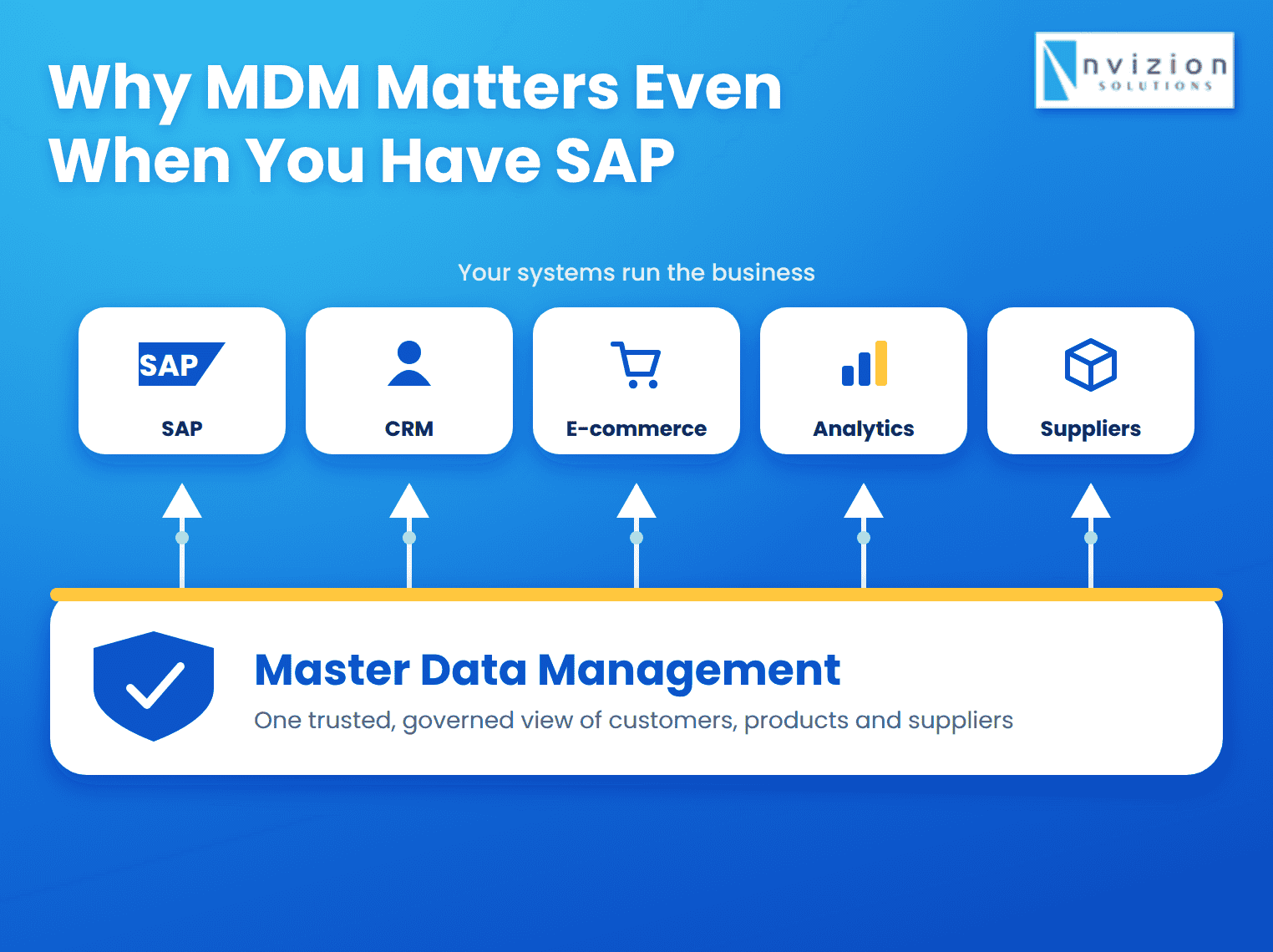
The Real Challenge Is Trust, Not Storage
In today’s enterprise landscape, SAP is rarely the only system that creates, updates, or consumes master data. Most organizations operate a complex ecosystem that includes CRM platforms, e-commerce engines, marketing and customer experience tools, partner and supplier portals, data lakes, analytics platforms, legacy systems, and a growing number of cloud applications.
Each of these systems frequently maintains its own version of the same business entities. A single customer may appear in SAP with one set of details, in the CRM with slightly different contact information, and in a digital platform with yet another variation, or even as a duplicate record. Product hierarchies may diverge across systems. Supplier records may conflict. Addresses, identifiers, and relationships slowly drift out of alignment.
As a result, the fundamental problem shifts. It is no longer simply a question of “Where is my data?” It becomes a far more difficult question: “Which version of this data can I trust?
When different systems present conflicting views of the same customer, product, or supplier, decision-making slows, operational efficiency drops, customer experience suffers, and compliance risk rises. This is the enterprise master data challenge, and it cannot be solved by any single operational system alone.
What Master Data Management Actually Delivers
Master Data Management addresses this challenge directly. MDM is not another place to store data. It is a disciplined approach, supported by technology, that creates a trusted, governed, and consistent view of critical business entities across the entire organization.
A mature MDM capability establishes clear data governance and stewardship so that ownership, policies, and accountability for data quality are well defined. It applies matching, merging, and survivorship rules to identify duplicates, resolve conflicts, and determine the most reliable attributes. It creates golden records, which are single, trusted versions of each master data entity that the business can rely on.
It also manages hierarchies and relationships so that organizational structures, product families, customer hierarchies, and supplier networks remain accurate. Structured workflows support data creation, enrichment, approval, and ongoing maintenance, while consistent distribution ensures that clean, governed master data reaches every consuming system.
In essence, MDM establishes the foundation of trust that operational systems depend on but cannot fully create by themselves.
SAP Runs the Business. MDM Builds Trust in the Data
SAP and similar enterprise platforms excel at running core business processes such as order-to-cash, procure-to-pay, and plan-to-produce. They manage transactional data with high integrity within their own boundaries. What they are not designed to do is act as the single source of truth for master data across a heterogeneous, multi-system landscape.
This is why SAP and MDM should not be viewed as competitors. In well-designed architectures they work together. SAP remains a primary system of record for many operational processes, while MDM becomes the system of reference for master data quality, consistency, and enterprise-wide distribution.
The more an organization grows, adding channels, partners, digital touchpoints, analytics platforms, and specialized applications, the more critical this separation of concerns becomes. Relying solely on any one operational system to maintain enterprise master data integrity eventually reaches its limits.
When MDM Becomes Necessary
Organizations typically begin to feel the need for dedicated MDM when multiple systems create or update the same master data entities. Data quality issues such as duplicates, incompleteness, or inconsistencies start affecting operations or analytics. Different departments and systems present conflicting views of customers, products, or suppliers.
The need also becomes clear when regulatory or reporting requirements demand a governed and auditable view of master data, or when digital transformation, mergers and acquisitions, or expansion into new channels multiplies the number of data sources and consumers.
At that point the question is no longer whether SAP or any other ERP is powerful enough. The real question is whether the organization has a deliberate strategy for creating and maintaining trusted master data across its entire ecosystem.
The Better Question to Ask
Instead of asking “Do we already have SAP?”, leaders should ask a more revealing question: “Do we have a trusted and governed view of our master data across the entire enterprise?”
If the answer is yes, supported by clear ownership, quality processes, and consistent distribution, then the foundation may already be in place. If the answer is no, then MDM is not an optional extra. It is the missing capability that turns fragmented data into a strategic asset.
Master Data Management does not compete with operational systems. It elevates them. By establishing trust in the data that flows across the business, MDM enables better decisions, smoother operations, stronger customer experiences, and more reliable analytics.
The organizations that treat master data as a strategic asset rather than a byproduct of individual systems are the ones best positioned to scale with confidence in an increasingly complex digital landscape.
What has been your experience? Has your organization been able to maintain enterprise-wide master data trust using operational systems alone, or did the growing complexity of the landscape eventually require a dedicated MDM approach?
Faq
Insights
Looking for resources, tools, tips and industry news? Stay ahead of the curve with quick access to thought leadership and expert insights on digital transformation.