
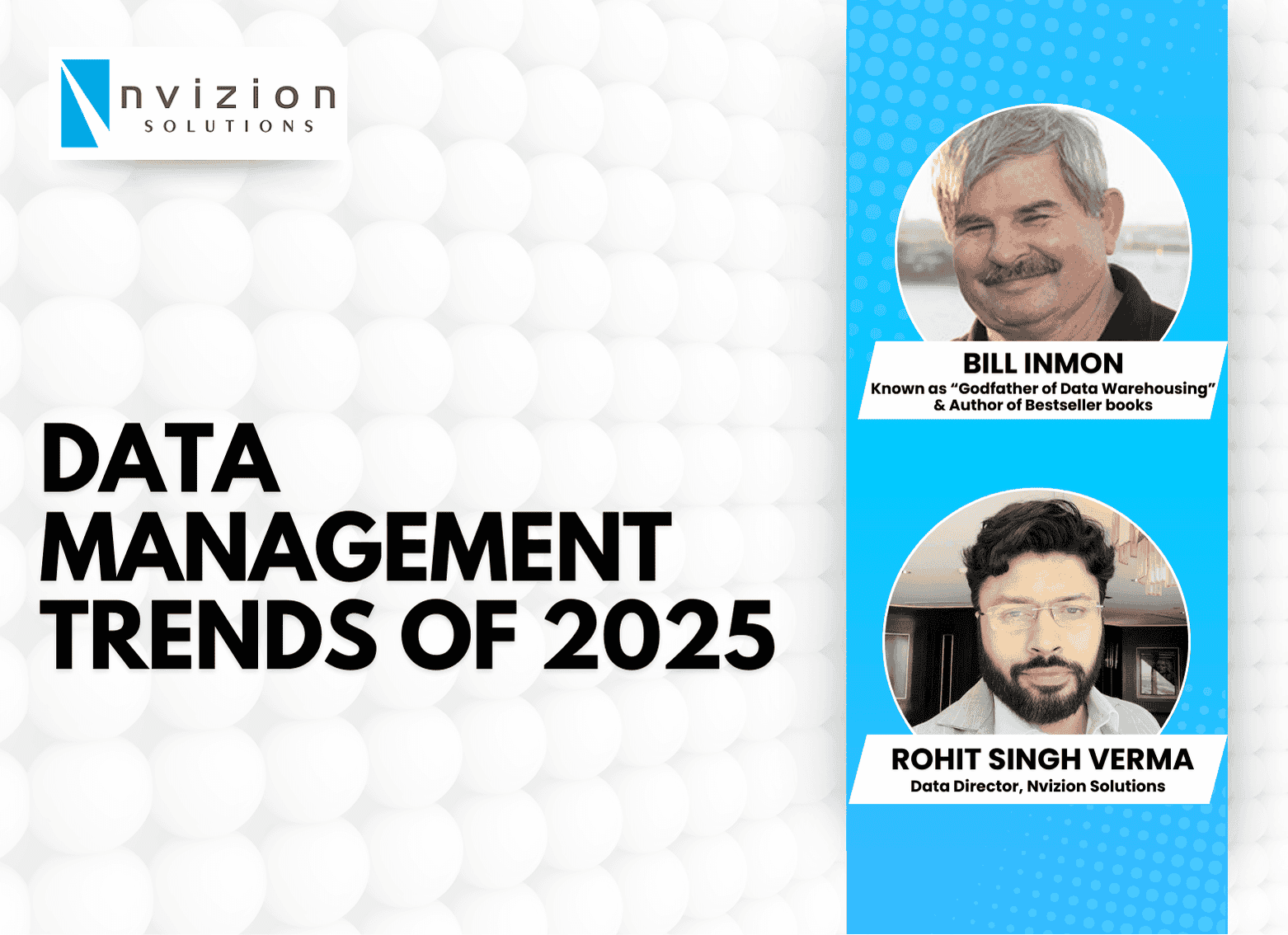
Unlocking the Future of Data Management: Insights from Bill Inmon on Nvizion Podcast
In This Article
- Key Insights from Bill Inmon: The Future of Data Management, MDM, and Enterprise Data Strategy
- Moving Beyond Application-Centric Data with the Top-Down Approach
- Addressing Data Duplication Through Transformation and MDM
- Why Master Data Management Is Essential for Enterprise Data Success
- The Role of Modern Data Architectures
- Key Takeaway: Data Strategy Starts with Trust
Key Insights from Bill Inmon: The Future of Data Management, MDM, and Enterprise Data Strategy
In the rapidly evolving world of enterprise data management, few voices carry as much influence as Bill Inmon, widely recognized as the father of data warehousing.
In a recent episode of the Nvizion Podcast, Bill shared his perspectives on some of the most critical topics shaping modern data strategies, including the top-down approach to data architecture, Master Data Management (MDM), data lakes, cloud modernization, and the growing importance of unstructured and textual data.
The conversation provided valuable insights into how organizations can build stronger data foundations and create enterprise-wide visibility in an increasingly complex data landscape.
Moving Beyond Application-Centric Data with the Top-Down Approach
One of Bill Inmon’s most recognized contributions to data architecture is the top-down approach to enterprise data management.
During the conversation, Bill explained that the top-down approach starts by understanding data across the entire enterprise rather than focusing only on individual applications.
Traditional application-driven approaches often create isolated data environments where each system maintains its own definitions, structures, and records. While individual applications may function effectively, combining data from multiple applications does not automatically create a unified enterprise view.
As Bill highlighted, application-driven data strategies often result in fragmented insights because each system represents only a portion of the business.
The top-down approach addresses this challenge by first understanding enterprise data requirements, relationships, and structures before designing solutions. This enables organizations to create a consistent data foundation that supports multiple departments, including finance, marketing, operations, and customer-facing teams.
Addressing Data Duplication Through Transformation and MDM
Duplicate data remains one of the most common challenges organizations face as they operate across multiple applications and platforms.
During the podcast, Bill emphasized the importance of transformation technologies, commonly associated with ETL (Extract, Transform, Load) processes, in identifying and resolving duplicate records.
Transformation processes help organizations analyze conflicting records, determine which information is accurate, and create more reliable datasets.
However, resolving duplicates is not only a technical challenge. It also requires strong Master Data Management practices.
MDM provides the framework needed to identify authoritative records, establish trusted versions of critical business entities, and ensure that customer, product, supplier, and other master data remains accurate across the enterprise.
As organizations continue to expand their digital ecosystems, MDM becomes increasingly important in maintaining consistency and trust across systems.
Why Master Data Management Is Essential for Enterprise Data Success
Although MDM has become a critical component of modern data strategies, many organizations historically treated it as a secondary priority.
Bill pointed out that master data management was often postponed during application development, with organizations focusing first on individual systems and addressing data consistency challenges later.
However, as enterprises attempt to create a unified view of their business, the importance of MDM becomes clear.
Without trusted master data, organizations struggle to connect information across departments, improve analytics accuracy, and create reliable insights.
MDM provides the foundation required for enterprise-wide data visibility by creating consistent definitions, improving data quality, removing duplicates, and enabling trusted information sharing across systems.
The Role of Modern Data Architectures
Beyond traditional data warehousing and MDM, the conversation also explored how modern technologies such as data lakes and cloud platforms are changing enterprise data strategies.
Organizations today are managing increasingly diverse data types, including structured transactional data, machine-generated information, and large volumes of textual content.
Cloud modernization and scalable data platforms provide enterprises with the flexibility to store, process, and analyze these growing data volumes. However, technology alone is not enough.
The success of modern data initiatives depends on having a strong foundation of trusted, governed, and well-managed data.
Key Takeaway: Data Strategy Starts with Trust
The discussion with Bill Inmon reinforced an important message: enterprise data success begins with understanding and managing data as a strategic asset.
Organizations cannot create meaningful analytics, AI capabilities, or business insights without first establishing reliable data foundations.
A combination of enterprise-focused architecture, strong Master Data Management practices, effective governance, and modern data platforms enables organizations to move from fragmented information toward trusted intelligence.
At Nvizion Solutions, we help enterprises build scalable data foundations through MDM, data governance, data quality, cloud modernization, and advanced data management solutions.
Because the future of enterprise intelligence depends not just on having more data, but on having data that businesses can trust.

Faq
Insights
Looking for resources, tools, tips and industry news? Stay ahead of the curve with quick access to thought leadership and expert insights on digital transformation.

Back to ‘ABCD’ of Data: Master, Golden, Reference and Metadata
In this blog, we will discuss about the classification of data and describe the various categories of data (reporting, transactional, master, golden, reference, metadata, unstructured and big data).
Back to ‘ABCD’ of Data: Master, Golden, Reference and Metadata
In this blog, we will discuss about the classification of data and describe the various categories of data (reporting, transactional, master, golden, reference, metadata, unstructured and big data).
Back to ‘ABCD’ of Data: Master, Golden, Reference and Metadata
In this blog, we will discuss about the classification of data and describe the various categories of data (reporting, transactional, master, golden, reference, metadata, unstructured and big data).
.png)
Best Practices for Data Mapping and Transformation in Informatica PIM
Data mapping and transformation are critical components of any Product Information Management (PIM) implementation. In this blog post, we will discuss best practices for data mapping and transformation in the new multi-tenant SaaS Informatica PIM.
Best Practices for Data Mapping and Transformation in Informatica PIM
Data mapping and transformation are critical components of any Product Information Management (PIM) implementation. In this blog post, we will discuss best practices for data mapping and transformation in the new multi-tenant SaaS Informatica PIM.
Best Practices for Data Mapping and Transformation in Informatica PIM
Data mapping and transformation are critical components of any Product Information Management (PIM) implementation. In this blog post, we will discuss best practices for data mapping and transformation in the new multi-tenant SaaS Informatica PIM.

Common Mistakes to Avoid While Managing 360 Views of Your Business Data
The need to integrate data management services and take decisive decisions to run businesses is increasing day by day. Now is the time for your organization to understand the true value of master data management and implementation. But before that, it’s more important to avoid these 5 common mistakes while managing a 360 view of business data.
Common Mistakes to Avoid While Managing 360 Views of Your Business Data
The need to integrate data management services and take decisive decisions to run businesses is increasing day by day. Now is the time for your organization to understand the true value of master data management and implementation. But before that, it’s more important to avoid these 5 common mistakes while managing a 360 view of business data.
Common Mistakes to Avoid While Managing 360 Views of Your Business Data
The need to integrate data management services and take decisive decisions to run businesses is increasing day by day. Now is the time for your organization to understand the true value of master data management and implementation. But before that, it’s more important to avoid these 5 common mistakes while managing a 360 view of business data.