
Insights on Digital Transformation
Looking for resources, tools, tips and industry news? Stay ahead of the curve with quick access to our thought leadership and expert insights on digital transformation.
%20(1).png)
How AI Is Changing the Future of Master Data Management
AI is reshaping Master Data Management by helping organizations move beyond reactive data cleansing toward proactive, intelligent data management. From duplicate detection and product classification to continuous data quality monitoring, governance search, and agentic AI, organizations can reduce manual effort and improve confidence in their master data. Discover how AI can complement governance and human expertise to support better data-driven decisions.
How AI Is Changing the Future of Master Data Management
AI is reshaping Master Data Management by helping organizations move beyond reactive data cleansing toward proactive, intelligent data management. From duplicate detection and product classification to continuous data quality monitoring, governance search, and agentic AI, organizations can reduce manual effort and improve confidence in their master data. Discover how AI can complement governance and human expertise to support better data-driven decisions.
How AI Is Changing the Future of Master Data Management
AI is reshaping Master Data Management by helping organizations move beyond reactive data cleansing toward proactive, intelligent data management. From duplicate detection and product classification to continuous data quality monitoring, governance search, and agentic AI, organizations can reduce manual effort and improve confidence in their master data. Discover how AI can complement governance and human expertise to support better data-driven decisions.
%201.png)
Are B2B Commerce Platforms Solving Tomorrow's Problems?
This blog explores the growing gap between today's B2B commerce platforms and tomorrow's commerce challenges. It examines how platform limitations, technical debt, rigid architectures and complex integrations can restrict innovation and why businesses need to think beyond the platform itself.
Are B2B Commerce Platforms Solving Tomorrow's Problems?
This blog explores the growing gap between today's B2B commerce platforms and tomorrow's commerce challenges. It examines how platform limitations, technical debt, rigid architectures and complex integrations can restrict innovation and why businesses need to think beyond the platform itself.
Are B2B Commerce Platforms Solving Tomorrow's Problems?
This blog explores the growing gap between today's B2B commerce platforms and tomorrow's commerce challenges. It examines how platform limitations, technical debt, rigid architectures and complex integrations can restrict innovation and why businesses need to think beyond the platform itself.
%20(1).png)
Why Great E-Commerce Experiences Depend on Great Product MDM
Great e-commerce experiences depend on accurate, consistent, and trusted product data. This blog explores how Product MDM creates a strong data foundation that helps businesses deliver seamless, personalized, and consistent customer experiences across every commerce channel.
Why Great E-Commerce Experiences Depend on Great Product MDM
Great e-commerce experiences depend on accurate, consistent, and trusted product data. This blog explores how Product MDM creates a strong data foundation that helps businesses deliver seamless, personalized, and consistent customer experiences across every commerce channel.
Why Great E-Commerce Experiences Depend on Great Product MDM
Great e-commerce experiences depend on accurate, consistent, and trusted product data. This blog explores how Product MDM creates a strong data foundation that helps businesses deliver seamless, personalized, and consistent customer experiences across every commerce channel.
%201.png)
Vendure: A Commerce Platform for Composable Architecture
To power the future of Composable Commerce Nvizion Solutions partners with Vendure to build and deliver future ready commerce experience.
Vendure: A Commerce Platform for Composable Architecture
To power the future of Composable Commerce Nvizion Solutions partners with Vendure to build and deliver future ready commerce experience.
Vendure: A Commerce Platform for Composable Architecture
To power the future of Composable Commerce Nvizion Solutions partners with Vendure to build and deliver future ready commerce experience.
%201.jpg)
The Rise of Quick Commerce: Is 10-Minute Delivery the New Normal?
Quick commerce is rapidly reshaping retail by making ultra-fast delivery of groceries, medicines, and everyday essentials a standard expectation in many urban markets. Driven by advanced logistics, real-time inventory management, and ecommerce platform integration, the industry continues to grow at a remarkable pace worldwide. However, concerns around profitability, worker safety, regulatory compliance, and sustainability are prompting companies to rethink the race for 10-minute delivery. The future of quick commerce will likely be defined not by speed alone, but by the ability to balance convenience, efficiency, and long-term business sustainability.
The Rise of Quick Commerce: Is 10-Minute Delivery the New Normal?
Quick commerce is rapidly reshaping retail by making ultra-fast delivery of groceries, medicines, and everyday essentials a standard expectation in many urban markets. Driven by advanced logistics, real-time inventory management, and ecommerce platform integration, the industry continues to grow at a remarkable pace worldwide. However, concerns around profitability, worker safety, regulatory compliance, and sustainability are prompting companies to rethink the race for 10-minute delivery. The future of quick commerce will likely be defined not by speed alone, but by the ability to balance convenience, efficiency, and long-term business sustainability.
The Rise of Quick Commerce: Is 10-Minute Delivery the New Normal?
Quick commerce is rapidly reshaping retail by making ultra-fast delivery of groceries, medicines, and everyday essentials a standard expectation in many urban markets. Driven by advanced logistics, real-time inventory management, and ecommerce platform integration, the industry continues to grow at a remarkable pace worldwide. However, concerns around profitability, worker safety, regulatory compliance, and sustainability are prompting companies to rethink the race for 10-minute delivery. The future of quick commerce will likely be defined not by speed alone, but by the ability to balance convenience, efficiency, and long-term business sustainability.
.jpg)
Why Hyperlocal Commerce Models Are Going Global
Hyperlocal commerce is transforming urban retail by bringing inventory closer to consumers through dark stores and ultra-fast delivery networks. Powered by AI-driven forecasting, data-driven commerce, and advanced fulfillment technologies, the model is helping businesses meet rising consumer expectations for speed and convenience. What started as a local delivery experiment has evolved into a global retail blueprint, with cities worldwide adopting similar operating models. As the sector expands into new categories and services, hyperlocal commerce is becoming a foundational part of modern digital commerce ecosystems.
Why Hyperlocal Commerce Models Are Going Global
Hyperlocal commerce is transforming urban retail by bringing inventory closer to consumers through dark stores and ultra-fast delivery networks. Powered by AI-driven forecasting, data-driven commerce, and advanced fulfillment technologies, the model is helping businesses meet rising consumer expectations for speed and convenience. What started as a local delivery experiment has evolved into a global retail blueprint, with cities worldwide adopting similar operating models. As the sector expands into new categories and services, hyperlocal commerce is becoming a foundational part of modern digital commerce ecosystems.
Why Hyperlocal Commerce Models Are Going Global
Hyperlocal commerce is transforming urban retail by bringing inventory closer to consumers through dark stores and ultra-fast delivery networks. Powered by AI-driven forecasting, data-driven commerce, and advanced fulfillment technologies, the model is helping businesses meet rising consumer expectations for speed and convenience. What started as a local delivery experiment has evolved into a global retail blueprint, with cities worldwide adopting similar operating models. As the sector expands into new categories and services, hyperlocal commerce is becoming a foundational part of modern digital commerce ecosystems.
.jpg)
How commerce is moving beyond category pages and why it took so long
Commerce is shifting from category-based product listing pages to intent-led, AI-driven discovery as traditional PLPs fail to understand customer context and needs. This leads to friction, drop-offs, and generic shopping experiences where users are forced to rely on filters and comparisons rather than guided discovery. Shoppers think in real-life situations and goals, not categories, which highlights the limitations of current Ecommerce search & product discovery systems. The future of AI-driven commerce and b2b ecommerce solutions lies in building experiences that understand intent and context, not just keywords.
How commerce is moving beyond category pages and why it took so long
Commerce is shifting from category-based product listing pages to intent-led, AI-driven discovery as traditional PLPs fail to understand customer context and needs. This leads to friction, drop-offs, and generic shopping experiences where users are forced to rely on filters and comparisons rather than guided discovery. Shoppers think in real-life situations and goals, not categories, which highlights the limitations of current Ecommerce search & product discovery systems. The future of AI-driven commerce and b2b ecommerce solutions lies in building experiences that understand intent and context, not just keywords.
How commerce is moving beyond category pages and why it took so long
Commerce is shifting from category-based product listing pages to intent-led, AI-driven discovery as traditional PLPs fail to understand customer context and needs. This leads to friction, drop-offs, and generic shopping experiences where users are forced to rely on filters and comparisons rather than guided discovery. Shoppers think in real-life situations and goals, not categories, which highlights the limitations of current Ecommerce search & product discovery systems. The future of AI-driven commerce and b2b ecommerce solutions lies in building experiences that understand intent and context, not just keywords.
The Hidden Risk: What Happens When AI Runs on Ungoverned Master Data
Organisations are rushing into AI without fixing the master data underneath it, and that gap is where the real risk hides. When master data is duplicated, outdated, or inconsistent, AI does not smooth it out but scales the problem further. Strong data governance and AI governance working together is not a barrier to AI progress but the foundation that makes it reliable.
The Hidden Risk: What Happens When AI Runs on Ungoverned Master Data
Organisations are rushing into AI without fixing the master data underneath it, and that gap is where the real risk hides. When master data is duplicated, outdated, or inconsistent, AI does not smooth it out but scales the problem further. Strong data governance and AI governance working together is not a barrier to AI progress but the foundation that makes it reliable.
The Hidden Risk: What Happens When AI Runs on Ungoverned Master Data
Organisations are rushing into AI without fixing the master data underneath it, and that gap is where the real risk hides. When master data is duplicated, outdated, or inconsistent, AI does not smooth it out but scales the problem further. Strong data governance and AI governance working together is not a barrier to AI progress but the foundation that makes it reliable.

Enterprise Commerce Didn’t Get Simpler After Composable - It Just Shifted the Complexity
Composable commerce solved many limitations of traditional platforms, but it also introduced new operational challenges across integrations, governance, and team coordination. As enterprises adopt headless architectures, ecommerce ERP integration, and AI-powered commerce, long-term success now depends more on operational maturity than technology alone.
Enterprise Commerce Didn’t Get Simpler After Composable - It Just Shifted the Complexity
Composable commerce solved many limitations of traditional platforms, but it also introduced new operational challenges across integrations, governance, and team coordination. As enterprises adopt headless architectures, ecommerce ERP integration, and AI-powered commerce, long-term success now depends more on operational maturity than technology alone.
Enterprise Commerce Didn’t Get Simpler After Composable - It Just Shifted the Complexity
Composable commerce solved many limitations of traditional platforms, but it also introduced new operational challenges across integrations, governance, and team coordination. As enterprises adopt headless architectures, ecommerce ERP integration, and AI-powered commerce, long-term success now depends more on operational maturity than technology alone.
.jpg)
What Actually Makes a B2B Digital Commerce Transformation Successful
A successful B2B digital commerce transformation is not defined by go-live, but by real adoption across customers and sales teams. Most failures stem from misaligned processes, weak data foundations, and gaps between business reality and platform design. A strong digital commerce strategy focuses on aligning workflows, data, and architecture with how the business actually operates. Long-term success is seen in consistent usage, reduced manual effort, and continuous improvement after launch.
What Actually Makes a B2B Digital Commerce Transformation Successful
A successful B2B digital commerce transformation is not defined by go-live, but by real adoption across customers and sales teams. Most failures stem from misaligned processes, weak data foundations, and gaps between business reality and platform design. A strong digital commerce strategy focuses on aligning workflows, data, and architecture with how the business actually operates. Long-term success is seen in consistent usage, reduced manual effort, and continuous improvement after launch.
What Actually Makes a B2B Digital Commerce Transformation Successful
A successful B2B digital commerce transformation is not defined by go-live, but by real adoption across customers and sales teams. Most failures stem from misaligned processes, weak data foundations, and gaps between business reality and platform design. A strong digital commerce strategy focuses on aligning workflows, data, and architecture with how the business actually operates. Long-term success is seen in consistent usage, reduced manual effort, and continuous improvement after launch.
%201.png)
Agentic MDM: The Next Evolution of Master Data Management for AI-Driven Enterprises
This article explains how Agentic MDM transforms traditional master data management using AI-driven agents and adaptive workflows. It highlights the shift from manual governance to intelligent automation, enabling real-time data quality, faster decision-making, and scalable enterprise integration, helping organizations build AI-ready data foundations for modern digital ecosystems.
Agentic MDM: The Next Evolution of Master Data Management for AI-Driven Enterprises
This article explains how Agentic MDM transforms traditional master data management using AI-driven agents and adaptive workflows. It highlights the shift from manual governance to intelligent automation, enabling real-time data quality, faster decision-making, and scalable enterprise integration, helping organizations build AI-ready data foundations for modern digital ecosystems.
Agentic MDM: The Next Evolution of Master Data Management for AI-Driven Enterprises
This article explains how Agentic MDM transforms traditional master data management using AI-driven agents and adaptive workflows. It highlights the shift from manual governance to intelligent automation, enabling real-time data quality, faster decision-making, and scalable enterprise integration, helping organizations build AI-ready data foundations for modern digital ecosystems.
.png)
Beyond the Monolith: Why "Stable" is the New "Stagnant" in B2B Commerce
This article explores how legacy monolithic commerce platforms limit innovation in modern B2B environments. Using a leading US industrial distributor as an example, it shows how adopting a composable, API-driven architecture with BigCommerce, Next.js, and Contentstack improved agility, stability, and deployment speed, enabling faster innovation and long-term digital growth for sustainable competitive advantage
Beyond the Monolith: Why "Stable" is the New "Stagnant" in B2B Commerce
This article explores how legacy monolithic commerce platforms limit innovation in modern B2B environments. Using a leading US industrial distributor as an example, it shows how adopting a composable, API-driven architecture with BigCommerce, Next.js, and Contentstack improved agility, stability, and deployment speed, enabling faster innovation and long-term digital growth for sustainable competitive advantage
Beyond the Monolith: Why "Stable" is the New "Stagnant" in B2B Commerce
This article explores how legacy monolithic commerce platforms limit innovation in modern B2B environments. Using a leading US industrial distributor as an example, it shows how adopting a composable, API-driven architecture with BigCommerce, Next.js, and Contentstack improved agility, stability, and deployment speed, enabling faster innovation and long-term digital growth for sustainable competitive advantage
Why Product Data Is Becoming the Backbone of Digital Commerce
Product data has become the foundation of modern digital commerce, directly impacting discoverability, conversion, and customer experience. This article explains why poor data silently kills performance and how structured product data, powered by PIM and governance, enables scalable, AI-driven commerce growth.
Why Product Data Is Becoming the Backbone of Digital Commerce
Product data has become the foundation of modern digital commerce, directly impacting discoverability, conversion, and customer experience. This article explains why poor data silently kills performance and how structured product data, powered by PIM and governance, enables scalable, AI-driven commerce growth.
Why Product Data Is Becoming the Backbone of Digital Commerce
Product data has become the foundation of modern digital commerce, directly impacting discoverability, conversion, and customer experience. This article explains why poor data silently kills performance and how structured product data, powered by PIM and governance, enables scalable, AI-driven commerce growth.
%202.jpg)
7 AI Trends Shaping Agentic Commerce in 2026
Agentic commerce is emerging as a new model where AI agents actively participate in product discovery, evaluation, and even purchasing decisions. Instead of relying solely on traditional browsing or search, AI systems interpret user intent, analyze product data, and recommend or execute transactions automatically. This shift is transforming digital commerce infrastructure, requiring enterprises to invest in structured product data, real-time data architectures, API-driven systems, and strong governance frameworks. As AI-driven recommendations replace traditional search experiences, organizations that build reliable data foundations and AI-ready commerce systems will gain a competitive advantage in the evolving digital marketplace.
7 AI Trends Shaping Agentic Commerce in 2026
Agentic commerce is emerging as a new model where AI agents actively participate in product discovery, evaluation, and even purchasing decisions. Instead of relying solely on traditional browsing or search, AI systems interpret user intent, analyze product data, and recommend or execute transactions automatically. This shift is transforming digital commerce infrastructure, requiring enterprises to invest in structured product data, real-time data architectures, API-driven systems, and strong governance frameworks. As AI-driven recommendations replace traditional search experiences, organizations that build reliable data foundations and AI-ready commerce systems will gain a competitive advantage in the evolving digital marketplace.
7 AI Trends Shaping Agentic Commerce in 2026
Agentic commerce is emerging as a new model where AI agents actively participate in product discovery, evaluation, and even purchasing decisions. Instead of relying solely on traditional browsing or search, AI systems interpret user intent, analyze product data, and recommend or execute transactions automatically. This shift is transforming digital commerce infrastructure, requiring enterprises to invest in structured product data, real-time data architectures, API-driven systems, and strong governance frameworks. As AI-driven recommendations replace traditional search experiences, organizations that build reliable data foundations and AI-ready commerce systems will gain a competitive advantage in the evolving digital marketplace.
%202.jpg)
Why Real-Time Data Is the New Competitive Advantage in 2026
In today’s digital economy, real-time data has become a critical competitive advantage for organizations. Traditional batch-based data systems often create delays that lead to outdated insights, operational inefficiencies, and missed opportunities. This article explores how real-time data architectures enable enterprises to synchronize inventory, pricing, and customer information instantly across systems. It also highlights the role of event-driven master data management (MDM) in creating a dynamic, continuously updated data ecosystem. By enabling faster decision-making, improved operational accuracy, and more responsive customer experiences, real-time data is emerging as a key driver of business agility and competitive success in 2026.
Why Real-Time Data Is the New Competitive Advantage in 2026
In today’s digital economy, real-time data has become a critical competitive advantage for organizations. Traditional batch-based data systems often create delays that lead to outdated insights, operational inefficiencies, and missed opportunities. This article explores how real-time data architectures enable enterprises to synchronize inventory, pricing, and customer information instantly across systems. It also highlights the role of event-driven master data management (MDM) in creating a dynamic, continuously updated data ecosystem. By enabling faster decision-making, improved operational accuracy, and more responsive customer experiences, real-time data is emerging as a key driver of business agility and competitive success in 2026.
Why Real-Time Data Is the New Competitive Advantage in 2026
In today’s digital economy, real-time data has become a critical competitive advantage for organizations. Traditional batch-based data systems often create delays that lead to outdated insights, operational inefficiencies, and missed opportunities. This article explores how real-time data architectures enable enterprises to synchronize inventory, pricing, and customer information instantly across systems. It also highlights the role of event-driven master data management (MDM) in creating a dynamic, continuously updated data ecosystem. By enabling faster decision-making, improved operational accuracy, and more responsive customer experiences, real-time data is emerging as a key driver of business agility and competitive success in 2026.
%201.jpg)
Preparing Your Commerce Architecture for Machine Decision-Makers
This article explains that preparing for AI-driven commerce is primarily an architectural challenge rather than a front-end design problem. As machine agents begin making purchasing decisions, competitive advantage will depend on structured, governed, and decision-ready data rather than visual storefront experiences. Enterprises must strengthen foundations such as Master Data Management, Product Information Management governance, real-time inventory visibility, and clear decision ownership. Organizations that standardize data, pricing logic, and governance frameworks before introducing automation will be best positioned for machine-led commerce ecosystems.
Preparing Your Commerce Architecture for Machine Decision-Makers
This article explains that preparing for AI-driven commerce is primarily an architectural challenge rather than a front-end design problem. As machine agents begin making purchasing decisions, competitive advantage will depend on structured, governed, and decision-ready data rather than visual storefront experiences. Enterprises must strengthen foundations such as Master Data Management, Product Information Management governance, real-time inventory visibility, and clear decision ownership. Organizations that standardize data, pricing logic, and governance frameworks before introducing automation will be best positioned for machine-led commerce ecosystems.
Preparing Your Commerce Architecture for Machine Decision-Makers
This article explains that preparing for AI-driven commerce is primarily an architectural challenge rather than a front-end design problem. As machine agents begin making purchasing decisions, competitive advantage will depend on structured, governed, and decision-ready data rather than visual storefront experiences. Enterprises must strengthen foundations such as Master Data Management, Product Information Management governance, real-time inventory visibility, and clear decision ownership. Organizations that standardize data, pricing logic, and governance frameworks before introducing automation will be best positioned for machine-led commerce ecosystems.
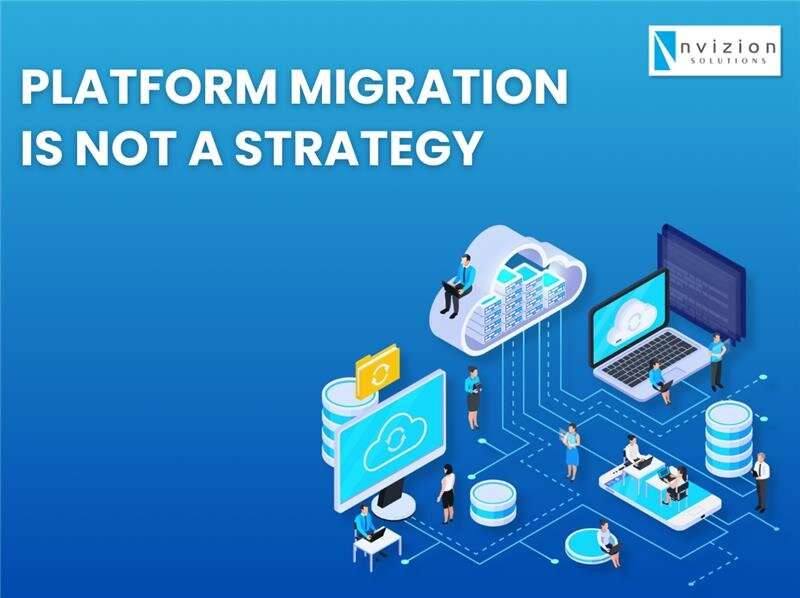
Platform Migration Is Not a Strategy
This article argues that migrating to a new commerce platform is often mistaken for strategic progress when it actually distracts from deeper operational issues. Many enterprises struggle with incomplete product data, checkout friction, unmanaged discounting, weak post-purchase engagement, and fragmented ownership of commerce performance. Technology alone cannot fix these problems—it only amplifies them. Real transformation begins with operational excellence: improving data quality, pricing discipline, conversion flows, and accountability before investing in new platforms. When fundamentals are strong, technology becomes a true accelerator rather than an expensive distraction.
Platform Migration Is Not a Strategy
This article argues that migrating to a new commerce platform is often mistaken for strategic progress when it actually distracts from deeper operational issues. Many enterprises struggle with incomplete product data, checkout friction, unmanaged discounting, weak post-purchase engagement, and fragmented ownership of commerce performance. Technology alone cannot fix these problems—it only amplifies them. Real transformation begins with operational excellence: improving data quality, pricing discipline, conversion flows, and accountability before investing in new platforms. When fundamentals are strong, technology becomes a true accelerator rather than an expensive distraction.
Platform Migration Is Not a Strategy
This article argues that migrating to a new commerce platform is often mistaken for strategic progress when it actually distracts from deeper operational issues. Many enterprises struggle with incomplete product data, checkout friction, unmanaged discounting, weak post-purchase engagement, and fragmented ownership of commerce performance. Technology alone cannot fix these problems—it only amplifies them. Real transformation begins with operational excellence: improving data quality, pricing discipline, conversion flows, and accountability before investing in new platforms. When fundamentals are strong, technology becomes a true accelerator rather than an expensive distraction.
%202.jpg)
Agentic Commerce Isn’t a Technology Problem — It’s a Decision Problem
Agentic commerce is not limited by technology maturity but by decision maturity. While AI agents can automate research, pricing, and transactions, enterprises often lack structured, governed, and repeatable decision frameworks. Automation scales clarity — not ambiguity. Organizations must identify which commerce decisions are mature enough for autonomy before deploying agentic models. Nvizion approaches agentic commerce as a decision architecture initiative, aligning data, governance, and systems integration to enable scalable, controlled autonomy.
Agentic Commerce Isn’t a Technology Problem — It’s a Decision Problem
Agentic commerce is not limited by technology maturity but by decision maturity. While AI agents can automate research, pricing, and transactions, enterprises often lack structured, governed, and repeatable decision frameworks. Automation scales clarity — not ambiguity. Organizations must identify which commerce decisions are mature enough for autonomy before deploying agentic models. Nvizion approaches agentic commerce as a decision architecture initiative, aligning data, governance, and systems integration to enable scalable, controlled autonomy.
Agentic Commerce Isn’t a Technology Problem — It’s a Decision Problem
Agentic commerce is not limited by technology maturity but by decision maturity. While AI agents can automate research, pricing, and transactions, enterprises often lack structured, governed, and repeatable decision frameworks. Automation scales clarity — not ambiguity. Organizations must identify which commerce decisions are mature enough for autonomy before deploying agentic models. Nvizion approaches agentic commerce as a decision architecture initiative, aligning data, governance, and systems integration to enable scalable, controlled autonomy.
%201.png)
Is Your AI Only as Smart as Your Data? The MDM Reality Check
Artificial Intelligence is only as effective as the data foundation supporting it. This article explores why Master Data Management (MDM) is critical to AI success, highlighting the importance of golden records, harmonized taxonomies, governance, and data standardization. Without unified and trustworthy master data, AI amplifies inconsistencies and bias. Enterprises must strengthen their MDM maturity before scaling AI initiatives. Nvizion helps organizations transform fragmented data environments into governed, AI-ready ecosystems built for intelligent commerce.
Is Your AI Only as Smart as Your Data? The MDM Reality Check
Artificial Intelligence is only as effective as the data foundation supporting it. This article explores why Master Data Management (MDM) is critical to AI success, highlighting the importance of golden records, harmonized taxonomies, governance, and data standardization. Without unified and trustworthy master data, AI amplifies inconsistencies and bias. Enterprises must strengthen their MDM maturity before scaling AI initiatives. Nvizion helps organizations transform fragmented data environments into governed, AI-ready ecosystems built for intelligent commerce.
Is Your AI Only as Smart as Your Data? The MDM Reality Check
Artificial Intelligence is only as effective as the data foundation supporting it. This article explores why Master Data Management (MDM) is critical to AI success, highlighting the importance of golden records, harmonized taxonomies, governance, and data standardization. Without unified and trustworthy master data, AI amplifies inconsistencies and bias. Enterprises must strengthen their MDM maturity before scaling AI initiatives. Nvizion helps organizations transform fragmented data environments into governed, AI-ready ecosystems built for intelligent commerce.

From Assisted Buying to Autonomous Buying: Preparing Commerce for AI Decision-Makers
As AI agents evolve from assistants to autonomous buyers, commerce must prepare for machine-led decision-making. This article explores the shift from user experience (UX) to machine experience (MX), how AI evaluates products differently than humans, and the resulting impact on merchandising and pricing strategies. It also outlines governance and control mechanisms enterprises need to enable secure, policy-aligned agent-led transactions in an increasingly autonomous commerce ecosystem.
From Assisted Buying to Autonomous Buying: Preparing Commerce for AI Decision-Makers
As AI agents evolve from assistants to autonomous buyers, commerce must prepare for machine-led decision-making. This article explores the shift from user experience (UX) to machine experience (MX), how AI evaluates products differently than humans, and the resulting impact on merchandising and pricing strategies. It also outlines governance and control mechanisms enterprises need to enable secure, policy-aligned agent-led transactions in an increasingly autonomous commerce ecosystem.
From Assisted Buying to Autonomous Buying: Preparing Commerce for AI Decision-Makers
As AI agents evolve from assistants to autonomous buyers, commerce must prepare for machine-led decision-making. This article explores the shift from user experience (UX) to machine experience (MX), how AI evaluates products differently than humans, and the resulting impact on merchandising and pricing strategies. It also outlines governance and control mechanisms enterprises need to enable secure, policy-aligned agent-led transactions in an increasingly autonomous commerce ecosystem.
5 MDM Mistakes We See in Real Enterprises (And How to Fix Them)
Master Data Management initiatives often fail not due to technology, but execution gaps. This article explores five real enterprise mistakes—including treating MDM as a one-time project, weak governance, over-customization, poor change management, and lack of system alignment. It outlines practical fixes such as phased rollouts, domain-led governance, KPI-driven data quality tracking, and integration-first architecture—positioning MDM as a long-term, business-critical data foundation.
5 MDM Mistakes We See in Real Enterprises (And How to Fix Them)
Master Data Management initiatives often fail not due to technology, but execution gaps. This article explores five real enterprise mistakes—including treating MDM as a one-time project, weak governance, over-customization, poor change management, and lack of system alignment. It outlines practical fixes such as phased rollouts, domain-led governance, KPI-driven data quality tracking, and integration-first architecture—positioning MDM as a long-term, business-critical data foundation.
5 MDM Mistakes We See in Real Enterprises (And How to Fix Them)
Master Data Management initiatives often fail not due to technology, but execution gaps. This article explores five real enterprise mistakes—including treating MDM as a one-time project, weak governance, over-customization, poor change management, and lack of system alignment. It outlines practical fixes such as phased rollouts, domain-led governance, KPI-driven data quality tracking, and integration-first architecture—positioning MDM as a long-term, business-critical data foundation.
Building a Data-First Culture: Why MDM Is More Than Just Technology
Master Data Management (MDM) programs often fail when treated purely as technology initiatives rather than cultural transformations. Building a data-first culture requires clear ownership, stewardship, governance balance, and embedded accountability across business teams. Sustainable data quality emerges when processes, incentives, and change management align with platform enablement. Organizations that operationalize data responsibility unlock stronger analytics, AI readiness, and scalable transformation — turning MDM from a system deployment into an enterprise capability.
Building a Data-First Culture: Why MDM Is More Than Just Technology
Master Data Management (MDM) programs often fail when treated purely as technology initiatives rather than cultural transformations. Building a data-first culture requires clear ownership, stewardship, governance balance, and embedded accountability across business teams. Sustainable data quality emerges when processes, incentives, and change management align with platform enablement. Organizations that operationalize data responsibility unlock stronger analytics, AI readiness, and scalable transformation — turning MDM from a system deployment into an enterprise capability.
Building a Data-First Culture: Why MDM Is More Than Just Technology
Master Data Management (MDM) programs often fail when treated purely as technology initiatives rather than cultural transformations. Building a data-first culture requires clear ownership, stewardship, governance balance, and embedded accountability across business teams. Sustainable data quality emerges when processes, incentives, and change management align with platform enablement. Organizations that operationalize data responsibility unlock stronger analytics, AI readiness, and scalable transformation — turning MDM from a system deployment into an enterprise capability.
Agentic Commerce Readiness: Why Decision Maturity Matters More Than Technology
Agentic commerce is gaining momentum, but successful adoption depends more on decision maturity than technology readiness. Organizations must evaluate whether their decisions are standardized, low-risk, and governance-backed before automating them. Early use cases should focus on bounded, rules-driven workflows to build trust. Premature deployment exposes operational gaps rather than solving them. Enterprises that prioritize decision design, ownership, and accountability will unlock agentic commerce value while minimizing risk and scaling autonomy responsibly.
Agentic Commerce Readiness: Why Decision Maturity Matters More Than Technology
Agentic commerce is gaining momentum, but successful adoption depends more on decision maturity than technology readiness. Organizations must evaluate whether their decisions are standardized, low-risk, and governance-backed before automating them. Early use cases should focus on bounded, rules-driven workflows to build trust. Premature deployment exposes operational gaps rather than solving them. Enterprises that prioritize decision design, ownership, and accountability will unlock agentic commerce value while minimizing risk and scaling autonomy responsibly.
Agentic Commerce Readiness: Why Decision Maturity Matters More Than Technology
Agentic commerce is gaining momentum, but successful adoption depends more on decision maturity than technology readiness. Organizations must evaluate whether their decisions are standardized, low-risk, and governance-backed before automating them. Early use cases should focus on bounded, rules-driven workflows to build trust. Premature deployment exposes operational gaps rather than solving them. Enterprises that prioritize decision design, ownership, and accountability will unlock agentic commerce value while minimizing risk and scaling autonomy responsibly.
%203.jpg)
From Headless to Head-Smart: Why 2026 Will Be About Decision-First Commerce Architecture (SI Perspective)
The article explores the evolution of commerce architecture from headless and composable models toward decision-first ecosystems. It argues that while modern stacks improved execution agility, they failed to unify operational decisioning. The next competitive advantage will come from centralized intelligence layers that orchestrate fulfillment, pricing, and service decisions in real time.
From Headless to Head-Smart: Why 2026 Will Be About Decision-First Commerce Architecture (SI Perspective)
The article explores the evolution of commerce architecture from headless and composable models toward decision-first ecosystems. It argues that while modern stacks improved execution agility, they failed to unify operational decisioning. The next competitive advantage will come from centralized intelligence layers that orchestrate fulfillment, pricing, and service decisions in real time.
From Headless to Head-Smart: Why 2026 Will Be About Decision-First Commerce Architecture (SI Perspective)
The article explores the evolution of commerce architecture from headless and composable models toward decision-first ecosystems. It argues that while modern stacks improved execution agility, they failed to unify operational decisioning. The next competitive advantage will come from centralized intelligence layers that orchestrate fulfillment, pricing, and service decisions in real time.
%201.png)
Snowflake vs Databricks: What Data & AI Leaders Should Choose and Why
This article helps enterprise data and AI leaders evaluate Snowflake and Databricks by clarifying their core differences, architectures, and ideal use cases. Snowflake excels in governed BI, structured analytics, and SQL-driven reporting, while Databricks leads in data engineering, machine learning, and GenAI at scale. It outlines workload fit, cost considerations, and industry perspectives, concluding that many organizations benefit from using both platforms strategically.
Snowflake vs Databricks: What Data & AI Leaders Should Choose and Why
This article helps enterprise data and AI leaders evaluate Snowflake and Databricks by clarifying their core differences, architectures, and ideal use cases. Snowflake excels in governed BI, structured analytics, and SQL-driven reporting, while Databricks leads in data engineering, machine learning, and GenAI at scale. It outlines workload fit, cost considerations, and industry perspectives, concluding that many organizations benefit from using both platforms strategically.
Snowflake vs Databricks: What Data & AI Leaders Should Choose and Why
This article helps enterprise data and AI leaders evaluate Snowflake and Databricks by clarifying their core differences, architectures, and ideal use cases. Snowflake excels in governed BI, structured analytics, and SQL-driven reporting, while Databricks leads in data engineering, machine learning, and GenAI at scale. It outlines workload fit, cost considerations, and industry perspectives, concluding that many organizations benefit from using both platforms strategically.
Navigating Data Compliance and Governance in 2026: Best Practices for Enterprises
In 2026, data compliance and governance have become strategic priorities that directly impact enterprise growth, AI adoption, and customer trust. As regulations tighten and data ecosystems grow more complex, organizations must move beyond manual, fragmented compliance models. By adopting privacy-first architectures, automation, and scalable governance frameworks, enterprises can reduce risk while transforming governance into a competitive advantage.
Navigating Data Compliance and Governance in 2026: Best Practices for Enterprises
In 2026, data compliance and governance have become strategic priorities that directly impact enterprise growth, AI adoption, and customer trust. As regulations tighten and data ecosystems grow more complex, organizations must move beyond manual, fragmented compliance models. By adopting privacy-first architectures, automation, and scalable governance frameworks, enterprises can reduce risk while transforming governance into a competitive advantage.
Navigating Data Compliance and Governance in 2026: Best Practices for Enterprises
In 2026, data compliance and governance have become strategic priorities that directly impact enterprise growth, AI adoption, and customer trust. As regulations tighten and data ecosystems grow more complex, organizations must move beyond manual, fragmented compliance models. By adopting privacy-first architectures, automation, and scalable governance frameworks, enterprises can reduce risk while transforming governance into a competitive advantage.

The Hidden Cost of ‘Good Enough’ Commerce: What Boards Don’t See Until It’s Too Late
“Good enough” commerce rarely fails outright — but it quietly drains growth, agility, and innovation. While boards see stability and steady revenue, delivery teams face mounting complexity, delayed launches, and operational friction. The real cost isn’t platform spend — it’s lost opportunity. Enterprises that modernize proactively turn commerce from a limiting system into a scalable growth engine.
The Hidden Cost of ‘Good Enough’ Commerce: What Boards Don’t See Until It’s Too Late
“Good enough” commerce rarely fails outright — but it quietly drains growth, agility, and innovation. While boards see stability and steady revenue, delivery teams face mounting complexity, delayed launches, and operational friction. The real cost isn’t platform spend — it’s lost opportunity. Enterprises that modernize proactively turn commerce from a limiting system into a scalable growth engine.
The Hidden Cost of ‘Good Enough’ Commerce: What Boards Don’t See Until It’s Too Late
“Good enough” commerce rarely fails outright — but it quietly drains growth, agility, and innovation. While boards see stability and steady revenue, delivery teams face mounting complexity, delayed launches, and operational friction. The real cost isn’t platform spend — it’s lost opportunity. Enterprises that modernize proactively turn commerce from a limiting system into a scalable growth engine.
%202.jpg)
The Traffic Apocalypse: Why Your 2026 Commerce Strategy Is Already Obsolete
As AI-powered search and autonomous agents reshape digital commerce, traditional traffic-driven strategies are rapidly becoming obsolete. This blog explores the rise of zero-click commerce, where AI systems research, compare, and complete purchases without users ever visiting a website. It explains why brands must shift from optimizing user journeys to delivering machine-readable product data, citation-ready content, and agent-friendly commerce infrastructure to remain visible, competitive, and relevant in 2026 and beyond.
The Traffic Apocalypse: Why Your 2026 Commerce Strategy Is Already Obsolete
As AI-powered search and autonomous agents reshape digital commerce, traditional traffic-driven strategies are rapidly becoming obsolete. This blog explores the rise of zero-click commerce, where AI systems research, compare, and complete purchases without users ever visiting a website. It explains why brands must shift from optimizing user journeys to delivering machine-readable product data, citation-ready content, and agent-friendly commerce infrastructure to remain visible, competitive, and relevant in 2026 and beyond.
The Traffic Apocalypse: Why Your 2026 Commerce Strategy Is Already Obsolete
As AI-powered search and autonomous agents reshape digital commerce, traditional traffic-driven strategies are rapidly becoming obsolete. This blog explores the rise of zero-click commerce, where AI systems research, compare, and complete purchases without users ever visiting a website. It explains why brands must shift from optimizing user journeys to delivering machine-readable product data, citation-ready content, and agent-friendly commerce infrastructure to remain visible, competitive, and relevant in 2026 and beyond.

Best Delivery Practices for Your eCommerce Project
Launching an eCommerce platform is complex, and success depends as much on delivery practices as on technology. From scope definition to post-launch hypercare, six proven practices covering governance, delivery models, integrations, QA, optimization, and collaboration help ensure a stable, scalable, and customer-friendly launch.
Best Delivery Practices for Your eCommerce Project
Launching an eCommerce platform is complex, and success depends as much on delivery practices as on technology. From scope definition to post-launch hypercare, six proven practices covering governance, delivery models, integrations, QA, optimization, and collaboration help ensure a stable, scalable, and customer-friendly launch.
Best Delivery Practices for Your eCommerce Project
Launching an eCommerce platform is complex, and success depends as much on delivery practices as on technology. From scope definition to post-launch hypercare, six proven practices covering governance, delivery models, integrations, QA, optimization, and collaboration help ensure a stable, scalable, and customer-friendly launch.
The Future of Cloud Data Management: Trends, Challenges, and Solutions
Cloud data management helps businesses store, secure, and use their data in flexible ways through cloud platforms. It offers big benefits like lower costs and easier access but also comes with risks like security and rising costs. Careful planning and the right tools are key for success.
The Future of Cloud Data Management: Trends, Challenges, and Solutions
Cloud data management helps businesses store, secure, and use their data in flexible ways through cloud platforms. It offers big benefits like lower costs and easier access but also comes with risks like security and rising costs. Careful planning and the right tools are key for success.
The Future of Cloud Data Management: Trends, Challenges, and Solutions
Cloud data management helps businesses store, secure, and use their data in flexible ways through cloud platforms. It offers big benefits like lower costs and easier access but also comes with risks like security and rising costs. Careful planning and the right tools are key for success.
%20(1).png)
How Nvizion Solutions is Revolutionizing Digital Commerce for Modern Businesses
Digital commerce goes beyond online sales, covering everything from customer experience to technology integration. It helps businesses reach wider audiences, reduce costs, and deliver personalized journeys. With the right tools and strategies, companies can thrive in this fast-changing digital landscape.
How Nvizion Solutions is Revolutionizing Digital Commerce for Modern Businesses
Digital commerce goes beyond online sales, covering everything from customer experience to technology integration. It helps businesses reach wider audiences, reduce costs, and deliver personalized journeys. With the right tools and strategies, companies can thrive in this fast-changing digital landscape.
How Nvizion Solutions is Revolutionizing Digital Commerce for Modern Businesses
Digital commerce goes beyond online sales, covering everything from customer experience to technology integration. It helps businesses reach wider audiences, reduce costs, and deliver personalized journeys. With the right tools and strategies, companies can thrive in this fast-changing digital landscape.
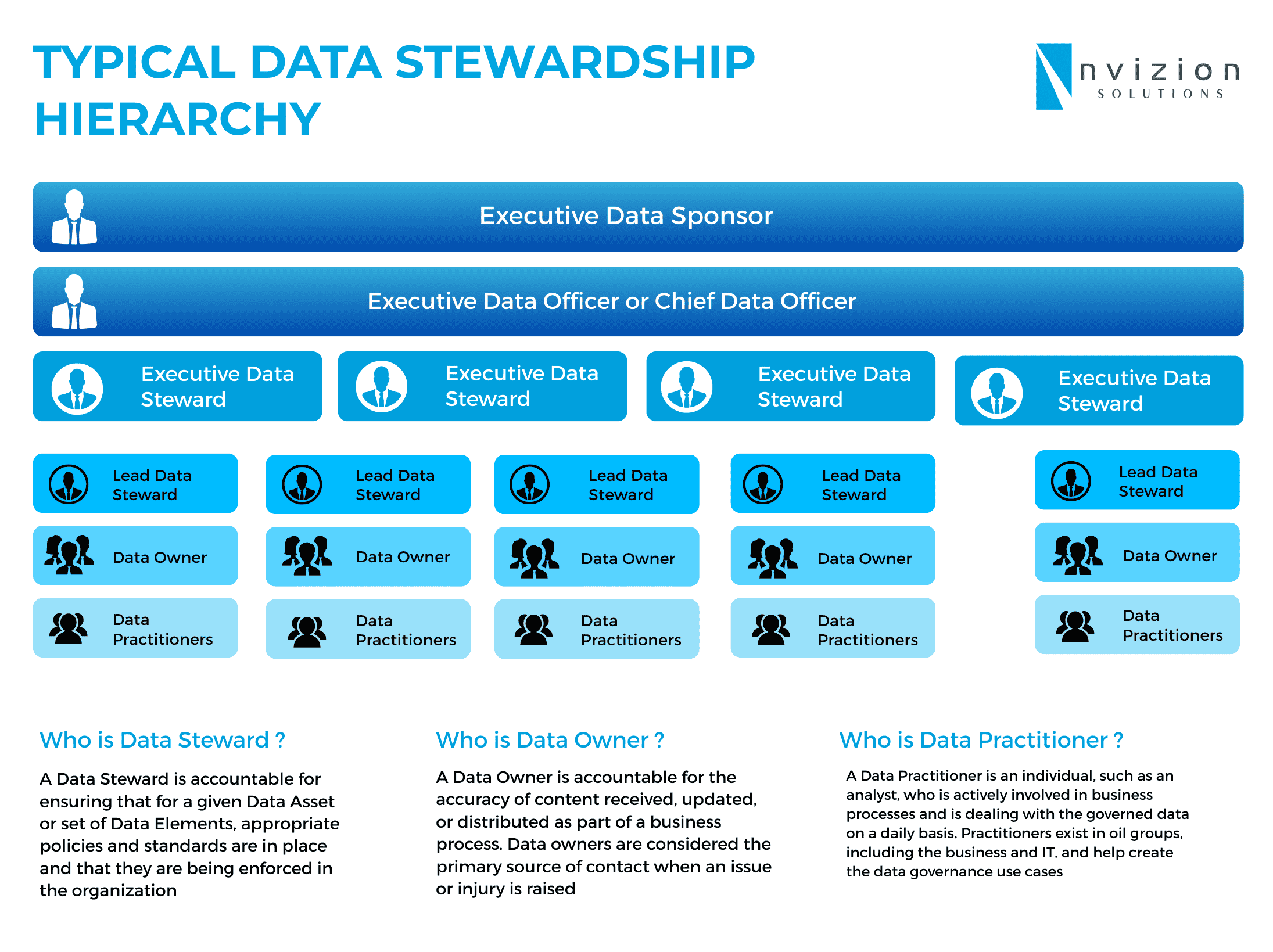
Data Stewardship Hierarchy Explained: A Practical Guide to Key Roles
Clear roles in data stewardship ensure accountability, consistency, and trust in how data is managed and used. From executives to practitioners, each role helps prevent chaos and turn data into a valuable asset. Nvizion Solutions guides businesses in building strong stewardship structures for reliable, secure data.
Data Stewardship Hierarchy Explained: A Practical Guide to Key Roles
Clear roles in data stewardship ensure accountability, consistency, and trust in how data is managed and used. From executives to practitioners, each role helps prevent chaos and turn data into a valuable asset. Nvizion Solutions guides businesses in building strong stewardship structures for reliable, secure data.
Data Stewardship Hierarchy Explained: A Practical Guide to Key Roles
Clear roles in data stewardship ensure accountability, consistency, and trust in how data is managed and used. From executives to practitioners, each role helps prevent chaos and turn data into a valuable asset. Nvizion Solutions guides businesses in building strong stewardship structures for reliable, secure data.
.png)
What is Product Information Management (PIM)? Why Your Business Needs It.
Product Information Management (PIM) centralizes and organizes all product data to keep it accurate and consistent across sales channels. It helps businesses reduce errors, launch products faster, and improve customer experiences. As digital commerce grows, PIM is essential for managing complex product information efficiently.
What is Product Information Management (PIM)? Why Your Business Needs It.
Product Information Management (PIM) centralizes and organizes all product data to keep it accurate and consistent across sales channels. It helps businesses reduce errors, launch products faster, and improve customer experiences. As digital commerce grows, PIM is essential for managing complex product information efficiently.
What is Product Information Management (PIM)? Why Your Business Needs It.
Product Information Management (PIM) centralizes and organizes all product data to keep it accurate and consistent across sales channels. It helps businesses reduce errors, launch products faster, and improve customer experiences. As digital commerce grows, PIM is essential for managing complex product information efficiently.
%20(1).png)
How Master Data Management Builds a Strong Data Foundation
Master Data Management (MDM) creates a single, trusted version of key business data by integrating, cleansing, matching, and governing information from multiple sources. It ensures data is accurate and consistent across both operational systems and analytics tools. Nvizion Solutions helps businesses implement MDM to improve data quality, support confident decision-making, and build trust organization-wide.
How Master Data Management Builds a Strong Data Foundation
Master Data Management (MDM) creates a single, trusted version of key business data by integrating, cleansing, matching, and governing information from multiple sources. It ensures data is accurate and consistent across both operational systems and analytics tools. Nvizion Solutions helps businesses implement MDM to improve data quality, support confident decision-making, and build trust organization-wide.
How Master Data Management Builds a Strong Data Foundation
Master Data Management (MDM) creates a single, trusted version of key business data by integrating, cleansing, matching, and governing information from multiple sources. It ensures data is accurate and consistent across both operational systems and analytics tools. Nvizion Solutions helps businesses implement MDM to improve data quality, support confident decision-making, and build trust organization-wide.
.png)
Mastering Your Data Journey: How the MDM Maturity Assessment Guides the Way
The MDM Maturity Assessment guides businesses from scattered data to data-driven success. Nvizion Solutions helps turn data into a strategic asset, unlocking real competitive advantage.
Mastering Your Data Journey: How the MDM Maturity Assessment Guides the Way
The MDM Maturity Assessment guides businesses from scattered data to data-driven success. Nvizion Solutions helps turn data into a strategic asset, unlocking real competitive advantage.
Mastering Your Data Journey: How the MDM Maturity Assessment Guides the Way
The MDM Maturity Assessment guides businesses from scattered data to data-driven success. Nvizion Solutions helps turn data into a strategic asset, unlocking real competitive advantage.

What is Composable Commerce?
Composable commerce lets businesses create flexible, customized digital experiences by combining the best technologies instead of relying on one rigid platform. It drives faster innovation and adaptability. Nvizion Solutions helps brands adopt composable commerce with tailored designs and seamless integrations for standout customer experience
What is Composable Commerce?
Composable commerce lets businesses create flexible, customized digital experiences by combining the best technologies instead of relying on one rigid platform. It drives faster innovation and adaptability. Nvizion Solutions helps brands adopt composable commerce with tailored designs and seamless integrations for standout customer experience
What is Composable Commerce?
Composable commerce lets businesses create flexible, customized digital experiences by combining the best technologies instead of relying on one rigid platform. It drives faster innovation and adaptability. Nvizion Solutions helps brands adopt composable commerce with tailored designs and seamless integrations for standout customer experience

What Is Digital Commerce? Everything You Need to Know
Digital commerce enables the buying and selling of goods and services online through platforms like BigCommerce, utilizing models such as B2B and C2C. Integrating BigCommerce with SAP, an enterprise resource planning (ERP) system, streamlines data exchange for customer information, orders, inventory, and pricing, enhancing operational efficiency
What Is Digital Commerce? Everything You Need to Know
Digital commerce enables the buying and selling of goods and services online through platforms like BigCommerce, utilizing models such as B2B and C2C. Integrating BigCommerce with SAP, an enterprise resource planning (ERP) system, streamlines data exchange for customer information, orders, inventory, and pricing, enhancing operational efficiency
What Is Digital Commerce? Everything You Need to Know
Digital commerce enables the buying and selling of goods and services online through platforms like BigCommerce, utilizing models such as B2B and C2C. Integrating BigCommerce with SAP, an enterprise resource planning (ERP) system, streamlines data exchange for customer information, orders, inventory, and pricing, enhancing operational efficiency
What Is MACH Architecture and Why Is It Important?
MACH stands for Microservices, API-first, Cloud-native, and Headless. It enables modular, scalable, and flexible systems that support rapid innovation and seamless integration. MACH architecture helps businesses deliver agile, omnichannel digital experiences while staying future-ready.
What Is MACH Architecture and Why Is It Important?
MACH stands for Microservices, API-first, Cloud-native, and Headless. It enables modular, scalable, and flexible systems that support rapid innovation and seamless integration. MACH architecture helps businesses deliver agile, omnichannel digital experiences while staying future-ready.
What Is MACH Architecture and Why Is It Important?
MACH stands for Microservices, API-first, Cloud-native, and Headless. It enables modular, scalable, and flexible systems that support rapid innovation and seamless integration. MACH architecture helps businesses deliver agile, omnichannel digital experiences while staying future-ready.
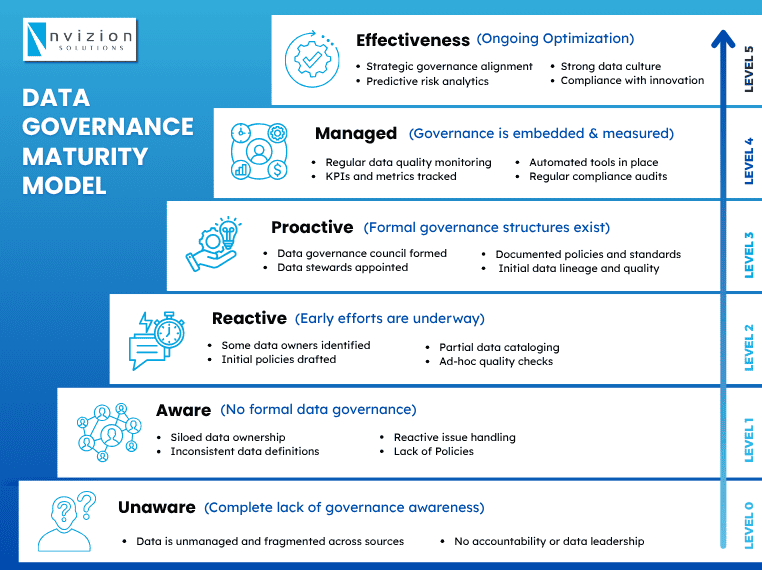
Data Governance Maturity Model: A Guide to Assessing and Improving Data Governance
In a fragmented data landscape, a Data Governance Maturity Model offers organizations a clear roadmap to evolve from disorganized data practices to fully governed, AI-ready ecosystems. Nvizion Solutions helps businesses assess their current maturity, define future goals, and implement tailored governance frameworks.
Data Governance Maturity Model: A Guide to Assessing and Improving Data Governance
In a fragmented data landscape, a Data Governance Maturity Model offers organizations a clear roadmap to evolve from disorganized data practices to fully governed, AI-ready ecosystems. Nvizion Solutions helps businesses assess their current maturity, define future goals, and implement tailored governance frameworks.
Data Governance Maturity Model: A Guide to Assessing and Improving Data Governance
In a fragmented data landscape, a Data Governance Maturity Model offers organizations a clear roadmap to evolve from disorganized data practices to fully governed, AI-ready ecosystems. Nvizion Solutions helps businesses assess their current maturity, define future goals, and implement tailored governance frameworks.
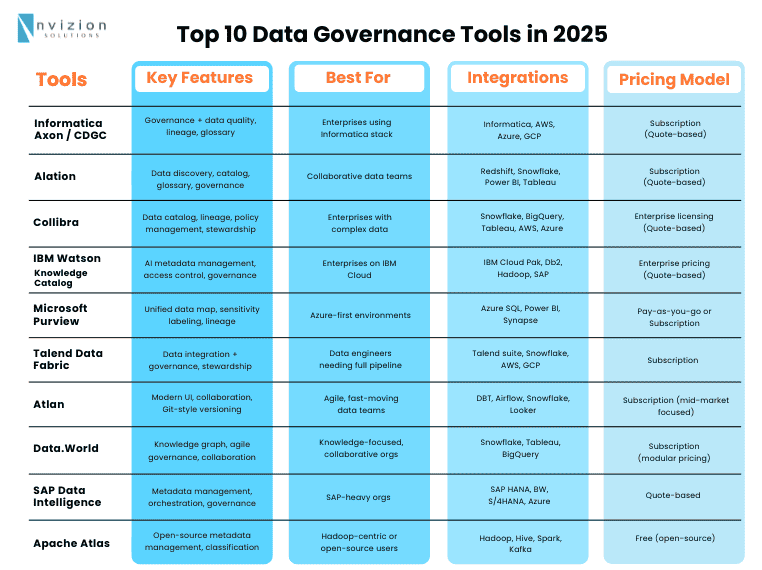
Top Data Governance Leading Solutions in 2025
Data governance has evolved into a strategic enabler, helping organizations manage data quality, lineage, metadata, and compliance across cloud and hybrid environments. Leading tools like Informatica Axon, Alation, Talend, and Microsoft Purview empower teams with trusted, discoverable data. At Nvizion Solutions, we help businesses implement and optimize these platforms for scalable, collaborative, and business-aligned data governance.
Top Data Governance Leading Solutions in 2025
Data governance has evolved into a strategic enabler, helping organizations manage data quality, lineage, metadata, and compliance across cloud and hybrid environments. Leading tools like Informatica Axon, Alation, Talend, and Microsoft Purview empower teams with trusted, discoverable data. At Nvizion Solutions, we help businesses implement and optimize these platforms for scalable, collaborative, and business-aligned data governance.
Top Data Governance Leading Solutions in 2025
Data governance has evolved into a strategic enabler, helping organizations manage data quality, lineage, metadata, and compliance across cloud and hybrid environments. Leading tools like Informatica Axon, Alation, Talend, and Microsoft Purview empower teams with trusted, discoverable data. At Nvizion Solutions, we help businesses implement and optimize these platforms for scalable, collaborative, and business-aligned data governance.
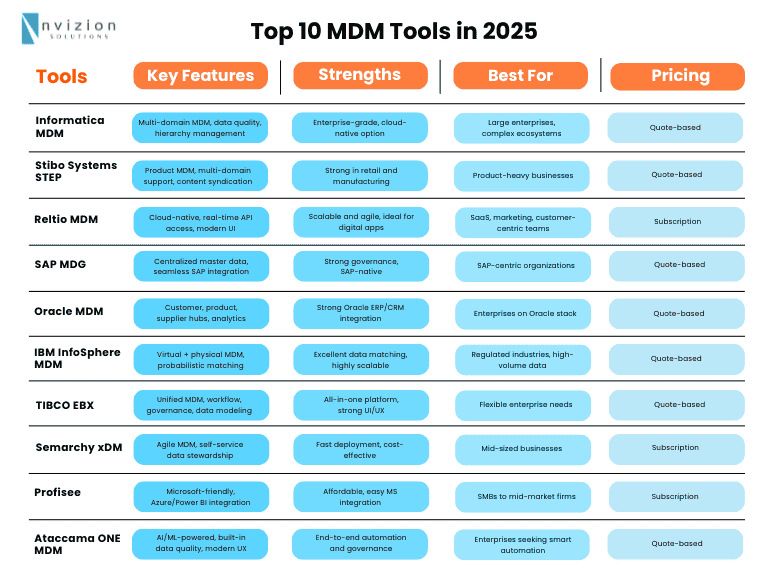
Top 10 MDM Tools in 2025: A Quick Guide to Today’s Leading Solutions
Choosing the right MDM tool depends on an organization’s unique data requirements, technology stack, and growth goals. At Nvizion Solutions, we help organizations select, implement, and optimize the right MDM platforms to drive better data quality, governance, and business outcomes.
Top 10 MDM Tools in 2025: A Quick Guide to Today’s Leading Solutions
Choosing the right MDM tool depends on an organization’s unique data requirements, technology stack, and growth goals. At Nvizion Solutions, we help organizations select, implement, and optimize the right MDM platforms to drive better data quality, governance, and business outcomes.
Top 10 MDM Tools in 2025: A Quick Guide to Today’s Leading Solutions
Choosing the right MDM tool depends on an organization’s unique data requirements, technology stack, and growth goals. At Nvizion Solutions, we help organizations select, implement, and optimize the right MDM platforms to drive better data quality, governance, and business outcomes.
.png)
Cloud Modernization: Transforming Your MDM and PowerCenter for Business Agility
Transform your business with cloud MDM and PowerCenter modernization to reduce costs, enhance data quality, and drive innovation through AI-powered, cloud-native data management.
Cloud Modernization: Transforming Your MDM and PowerCenter for Business Agility
Transform your business with cloud MDM and PowerCenter modernization to reduce costs, enhance data quality, and drive innovation through AI-powered, cloud-native data management.
Cloud Modernization: Transforming Your MDM and PowerCenter for Business Agility
Transform your business with cloud MDM and PowerCenter modernization to reduce costs, enhance data quality, and drive innovation through AI-powered, cloud-native data management.

BigCommerce and Noibu Partnership: Innovating Error-Free Ecommerce at MACH-Speed
Say goodbye to lost sales due to hidden errors! Discover how BigCommerce and Noibu’s game-changing partnership ensures seamless, error-free eCommerce—plus how Nvizion Solutions takes it to the next level.
BigCommerce and Noibu Partnership: Innovating Error-Free Ecommerce at MACH-Speed
Say goodbye to lost sales due to hidden errors! Discover how BigCommerce and Noibu’s game-changing partnership ensures seamless, error-free eCommerce—plus how Nvizion Solutions takes it to the next level.
BigCommerce and Noibu Partnership: Innovating Error-Free Ecommerce at MACH-Speed
Say goodbye to lost sales due to hidden errors! Discover how BigCommerce and Noibu’s game-changing partnership ensures seamless, error-free eCommerce—plus how Nvizion Solutions takes it to the next level.
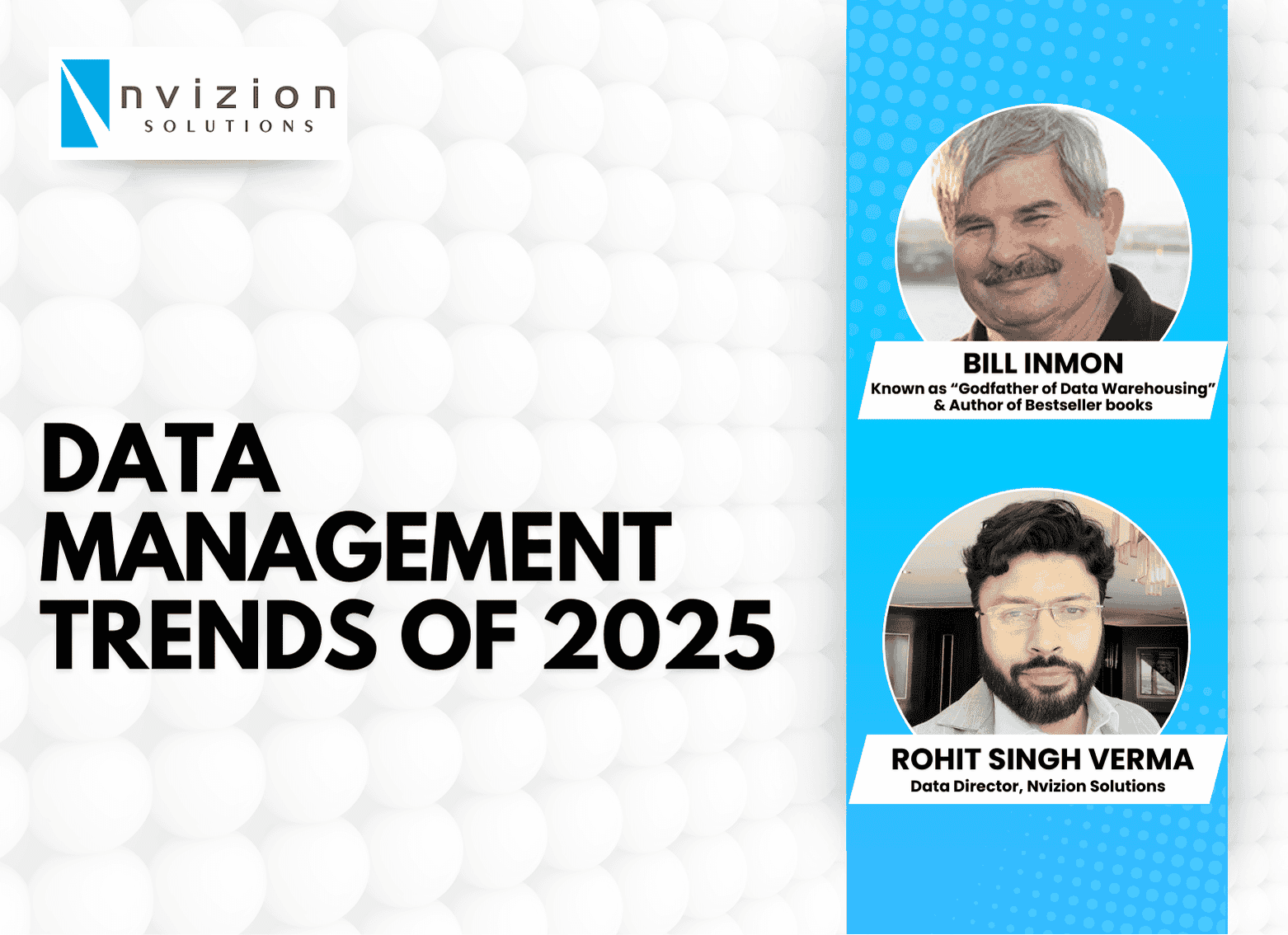
Unlocking the Future of Data Management: Insights from Bill Inmon on Nvizion Podcast
Gain exclusive insights from Bill Inmon, Father of Data Warehousing, on MDM, data lakes, and cloud modernization in the latest Nvizion Podcast!
Unlocking the Future of Data Management: Insights from Bill Inmon on Nvizion Podcast
Gain exclusive insights from Bill Inmon, Father of Data Warehousing, on MDM, data lakes, and cloud modernization in the latest Nvizion Podcast!
Unlocking the Future of Data Management: Insights from Bill Inmon on Nvizion Podcast
Gain exclusive insights from Bill Inmon, Father of Data Warehousing, on MDM, data lakes, and cloud modernization in the latest Nvizion Podcast!

Future of Master Data Management
Discover how the latest MDM trends—cloud, AI, and multi-domain integration—are reshaping eCommerce for smarter, faster, and more personalized customer experiences.
Future of Master Data Management
Discover how the latest MDM trends—cloud, AI, and multi-domain integration—are reshaping eCommerce for smarter, faster, and more personalized customer experiences.
Future of Master Data Management
Discover how the latest MDM trends—cloud, AI, and multi-domain integration—are reshaping eCommerce for smarter, faster, and more personalized customer experiences.
.png)
Navigating the Future: PIM Trends to Watch in 2024 and Beyond
In this blog, we'll delve into the key trends shaping the future of PIM and how businesses can leverage them to thrive in the ever-changing marketplace.
Navigating the Future: PIM Trends to Watch in 2024 and Beyond
In this blog, we'll delve into the key trends shaping the future of PIM and how businesses can leverage them to thrive in the ever-changing marketplace.
Navigating the Future: PIM Trends to Watch in 2024 and Beyond
In this blog, we'll delve into the key trends shaping the future of PIM and how businesses can leverage them to thrive in the ever-changing marketplace.
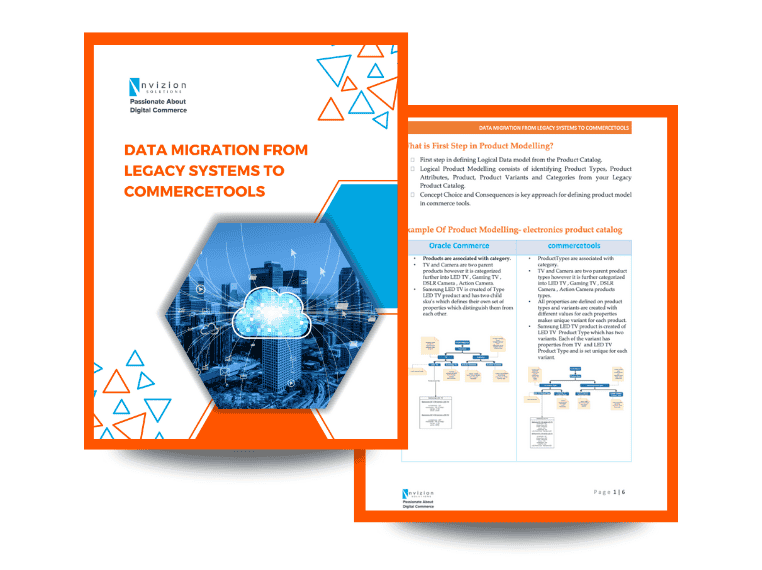
Data Migration from Legacy System to commercetools
Data Migration from Legacy Systems to commercetools
Data Migration from Legacy System to commercetools
Data Migration from Legacy Systems to commercetools
Data Migration from Legacy System to commercetools
Data Migration from Legacy Systems to commercetools
.png)
Informatica CLAIRE: The “Intelligence” in the Intelligent Data Management Cloud
In this blog, we will explore how Informatica's CLAIRE is transforming data management through its Intelligent Data Management Cloud and examine some real-world applications of this intelligence.
Informatica CLAIRE: The “Intelligence” in the Intelligent Data Management Cloud
In this blog, we will explore how Informatica's CLAIRE is transforming data management through its Intelligent Data Management Cloud and examine some real-world applications of this intelligence.
Informatica CLAIRE: The “Intelligence” in the Intelligent Data Management Cloud
In this blog, we will explore how Informatica's CLAIRE is transforming data management through its Intelligent Data Management Cloud and examine some real-world applications of this intelligence.
.png)
Webinar | Transformation from Mach to Monolith
In this Webinar, Harleen Ahuja, Director of Commerce, Nvizion Solutions, breaks down each component of MACH to understand how it contributes to creating the MACH Commerce platform.
Webinar | Transformation from Mach to Monolith
In this Webinar, Harleen Ahuja, Director of Commerce, Nvizion Solutions, breaks down each component of MACH to understand how it contributes to creating the MACH Commerce platform.
Webinar | Transformation from Mach to Monolith
In this Webinar, Harleen Ahuja, Director of Commerce, Nvizion Solutions, breaks down each component of MACH to understand how it contributes to creating the MACH Commerce platform.
.png)
Best Practices for Data Mapping and Transformation in Informatica PIM
Data mapping and transformation are critical components of any Product Information Management (PIM) implementation. In this blog post, we will discuss best practices for data mapping and transformation in the new multi-tenant SaaS Informatica PIM.
Best Practices for Data Mapping and Transformation in Informatica PIM
Data mapping and transformation are critical components of any Product Information Management (PIM) implementation. In this blog post, we will discuss best practices for data mapping and transformation in the new multi-tenant SaaS Informatica PIM.
Best Practices for Data Mapping and Transformation in Informatica PIM
Data mapping and transformation are critical components of any Product Information Management (PIM) implementation. In this blog post, we will discuss best practices for data mapping and transformation in the new multi-tenant SaaS Informatica PIM.
.png)
Building Commercetools extension
Wondering how to take your eCommerce website to the next level by building commercetools extensions? Whether you're looking to improve your product search functionality or enhance your customer experience, this guide will definitely help you!
Building Commercetools extension
Wondering how to take your eCommerce website to the next level by building commercetools extensions? Whether you're looking to improve your product search functionality or enhance your customer experience, this guide will definitely help you!
Building Commercetools extension
Wondering how to take your eCommerce website to the next level by building commercetools extensions? Whether you're looking to improve your product search functionality or enhance your customer experience, this guide will definitely help you!
.avif)
Nvizion Solutions Joins BigCommerce Partner Program
Nvizion Solutions offers BigCommerce Implementation and support to help fast-growing businesses enhance their eCommerce reach.
Nvizion Solutions Joins BigCommerce Partner Program
Nvizion Solutions offers BigCommerce Implementation and support to help fast-growing businesses enhance their eCommerce reach.
Nvizion Solutions Joins BigCommerce Partner Program
Nvizion Solutions offers BigCommerce Implementation and support to help fast-growing businesses enhance their eCommerce reach.
.png)
Transform from Monolithic to MACH
MACH emphasizes on creating an eCommerce platform that works purely on the cloud with Microservices, and APIs and is Headless. Now, let's break down each component of MACH to understand how it contributes to creating the MACH eCommerce platform.
Transform from Monolithic to MACH
MACH emphasizes on creating an eCommerce platform that works purely on the cloud with Microservices, and APIs and is Headless. Now, let's break down each component of MACH to understand how it contributes to creating the MACH eCommerce platform.
Transform from Monolithic to MACH
MACH emphasizes on creating an eCommerce platform that works purely on the cloud with Microservices, and APIs and is Headless. Now, let's break down each component of MACH to understand how it contributes to creating the MACH eCommerce platform.
.png)
Nvizion Solutions Is Now an SAP® Silver Partner
Nvizion Solutions announced today that it has achieved SAP Silver Partner status in the SAP® PartnerEdge® program. This is a clear indication of the high level of quality Nvizion Solutions provides to businesses using SAP solutions. Nvizion Solutions is built on SAP Business Technology Platform (SAPBTP) with SAP Integration Suite and integrates with SAP Customer Experience.
Nvizion Solutions Is Now an SAP® Silver Partner
Nvizion Solutions announced today that it has achieved SAP Silver Partner status in the SAP® PartnerEdge® program. This is a clear indication of the high level of quality Nvizion Solutions provides to businesses using SAP solutions. Nvizion Solutions is built on SAP Business Technology Platform (SAPBTP) with SAP Integration Suite and integrates with SAP Customer Experience.
Nvizion Solutions Is Now an SAP® Silver Partner
Nvizion Solutions announced today that it has achieved SAP Silver Partner status in the SAP® PartnerEdge® program. This is a clear indication of the high level of quality Nvizion Solutions provides to businesses using SAP solutions. Nvizion Solutions is built on SAP Business Technology Platform (SAPBTP) with SAP Integration Suite and integrates with SAP Customer Experience.

Common Mistakes to Avoid While Managing 360 Views of Your Business Data
The need to integrate data management services and take decisive decisions to run businesses is increasing day by day. Now is the time for your organization to understand the true value of master data management and implementation. But before that, it’s more important to avoid these 5 common mistakes while managing a 360 view of business data.
Common Mistakes to Avoid While Managing 360 Views of Your Business Data
The need to integrate data management services and take decisive decisions to run businesses is increasing day by day. Now is the time for your organization to understand the true value of master data management and implementation. But before that, it’s more important to avoid these 5 common mistakes while managing a 360 view of business data.
Common Mistakes to Avoid While Managing 360 Views of Your Business Data
The need to integrate data management services and take decisive decisions to run businesses is increasing day by day. Now is the time for your organization to understand the true value of master data management and implementation. But before that, it’s more important to avoid these 5 common mistakes while managing a 360 view of business data.

The State of Web Performance in 2020s
The last few years have seen tremendous innovation to improve performance, security, and user experience. This article talks about the impact innovations had to enhance user experience on a website over the years ad the web performance trends that will dominate in 2020s
The State of Web Performance in 2020s
The last few years have seen tremendous innovation to improve performance, security, and user experience. This article talks about the impact innovations had to enhance user experience on a website over the years ad the web performance trends that will dominate in 2020s
The State of Web Performance in 2020s
The last few years have seen tremendous innovation to improve performance, security, and user experience. This article talks about the impact innovations had to enhance user experience on a website over the years ad the web performance trends that will dominate in 2020s

Aza Fashions Registers 40% Increased Website Performance
Aza Fashions, Mumbai based luxury fashion retailer, recently tied up with N7 – The Nitrogen Platform to improve its online shopping experience for its customers.
Aza Fashions Registers 40% Increased Website Performance
Aza Fashions, Mumbai based luxury fashion retailer, recently tied up with N7 – The Nitrogen Platform to improve its online shopping experience for its customers.
Aza Fashions Registers 40% Increased Website Performance
Aza Fashions, Mumbai based luxury fashion retailer, recently tied up with N7 – The Nitrogen Platform to improve its online shopping experience for its customers.
.png)
Is SAP Spartacus Really a Good Jumpstart?
While starting a new SAP Commerce implementation project the decision is very simple: one should go with Spartacus, unless there are very specific reasons to implement a fully custom user interface. Read this blog to know more.
Is SAP Spartacus Really a Good Jumpstart?
While starting a new SAP Commerce implementation project the decision is very simple: one should go with Spartacus, unless there are very specific reasons to implement a fully custom user interface. Read this blog to know more.
Is SAP Spartacus Really a Good Jumpstart?
While starting a new SAP Commerce implementation project the decision is very simple: one should go with Spartacus, unless there are very specific reasons to implement a fully custom user interface. Read this blog to know more.
.png)
ET Round Table | Modern Security for Modern Commerce
ETRetail and N7 - The Nitrogen Platform come together with leading technology decision-makers from the e-commerce sector to share their thoughts, experience, and insights.
ET Round Table | Modern Security for Modern Commerce
ETRetail and N7 - The Nitrogen Platform come together with leading technology decision-makers from the e-commerce sector to share their thoughts, experience, and insights.
ET Round Table | Modern Security for Modern Commerce
ETRetail and N7 - The Nitrogen Platform come together with leading technology decision-makers from the e-commerce sector to share their thoughts, experience, and insights.

Ecommerce Holiday Readiness Guide for 2025 | Tips & Strategies
Retail's eCommerce share remains high, and so does its competition. Providing easy, flexible, and convenient options will make you your shoppers' favorite shopping destination. Let's first see some of the eCommerce trends for Holiday Season 2022.
Ecommerce Holiday Readiness Guide for 2025 | Tips & Strategies
Retail's eCommerce share remains high, and so does its competition. Providing easy, flexible, and convenient options will make you your shoppers' favorite shopping destination. Let's first see some of the eCommerce trends for Holiday Season 2022.
Ecommerce Holiday Readiness Guide for 2025 | Tips & Strategies
Retail's eCommerce share remains high, and so does its competition. Providing easy, flexible, and convenient options will make you your shoppers' favorite shopping destination. Let's first see some of the eCommerce trends for Holiday Season 2022.

Enhance your Digital Commerce Journey with PIM
Foundation stone for any e-Commerce or digital commerce is collecting and managing all product data. To grow the business, every organization needs to keep its products and services updated to benefit its customers. Let us check out the reasons why PIM is important for the digital commerce journey!
Enhance your Digital Commerce Journey with PIM
Foundation stone for any e-Commerce or digital commerce is collecting and managing all product data. To grow the business, every organization needs to keep its products and services updated to benefit its customers. Let us check out the reasons why PIM is important for the digital commerce journey!
Enhance your Digital Commerce Journey with PIM
Foundation stone for any e-Commerce or digital commerce is collecting and managing all product data. To grow the business, every organization needs to keep its products and services updated to benefit its customers. Let us check out the reasons why PIM is important for the digital commerce journey!
.png)
Improve SEO Ranking & Customer Experience with N7’s Core Web Vitals Tracker – ET Retail
Now, with the advent of Core Web Vitals, N7 has introduced another unique platform called WebVitalsTracker.io. Here’s how WebVitalsTracker.io stands out and creates a difference for web platforms
Improve SEO Ranking & Customer Experience with N7’s Core Web Vitals Tracker – ET Retail
Now, with the advent of Core Web Vitals, N7 has introduced another unique platform called WebVitalsTracker.io. Here’s how WebVitalsTracker.io stands out and creates a difference for web platforms
Improve SEO Ranking & Customer Experience with N7’s Core Web Vitals Tracker – ET Retail
Now, with the advent of Core Web Vitals, N7 has introduced another unique platform called WebVitalsTracker.io. Here’s how WebVitalsTracker.io stands out and creates a difference for web platforms
G2 Report | N7 recognized as High Performer under CDN Category
You can checkout the detailed G2 Report to see how Nitrogen compares to its competitors and read what our customers have to say about Nitrogen on G2 Reviews.
G2 Report | N7 recognized as High Performer under CDN Category
You can checkout the detailed G2 Report to see how Nitrogen compares to its competitors and read what our customers have to say about Nitrogen on G2 Reviews.
G2 Report | N7 recognized as High Performer under CDN Category
You can checkout the detailed G2 Report to see how Nitrogen compares to its competitors and read what our customers have to say about Nitrogen on G2 Reviews.

Hotfolder Cheatsheet
Hotfolder are still getting used largely because of their ease to use, we present here few tricks to make it even better and to solve all challenging situations.
Hotfolder Cheatsheet
Hotfolder are still getting used largely because of their ease to use, we present here few tricks to make it even better and to solve all challenging situations.
Hotfolder Cheatsheet
Hotfolder are still getting used largely because of their ease to use, we present here few tricks to make it even better and to solve all challenging situations.

Launch your Marketplace in 30 days
Scale your online store quickly by extending your SAP commerce platform with our marketplace extension. Our library of addons & best practices enable businesses to jumpstart marketplace implementation and expedite time-to-market by launching a marketplace in 30 days.
Launch your Marketplace in 30 days
Scale your online store quickly by extending your SAP commerce platform with our marketplace extension. Our library of addons & best practices enable businesses to jumpstart marketplace implementation and expedite time-to-market by launching a marketplace in 30 days.
Launch your Marketplace in 30 days
Scale your online store quickly by extending your SAP commerce platform with our marketplace extension. Our library of addons & best practices enable businesses to jumpstart marketplace implementation and expedite time-to-market by launching a marketplace in 30 days.

Confusion between Master Data and Reference Data: You are not Alone
In this blog, we will discuss about major misconception we build while dealing with data and the confusion we usually build between Master Data and Reference Data. Most will tell you that reference data is a subset of master data, and it is, sort of. But...
Confusion between Master Data and Reference Data: You are not Alone
In this blog, we will discuss about major misconception we build while dealing with data and the confusion we usually build between Master Data and Reference Data. Most will tell you that reference data is a subset of master data, and it is, sort of. But...
Confusion between Master Data and Reference Data: You are not Alone
In this blog, we will discuss about major misconception we build while dealing with data and the confusion we usually build between Master Data and Reference Data. Most will tell you that reference data is a subset of master data, and it is, sort of. But...

Back to ‘ABCD’ of Data: Master, Golden, Reference and Metadata
In this blog, we will discuss about the classification of data and describe the various categories of data (reporting, transactional, master, golden, reference, metadata, unstructured and big data).
Back to ‘ABCD’ of Data: Master, Golden, Reference and Metadata
In this blog, we will discuss about the classification of data and describe the various categories of data (reporting, transactional, master, golden, reference, metadata, unstructured and big data).
Back to ‘ABCD’ of Data: Master, Golden, Reference and Metadata
In this blog, we will discuss about the classification of data and describe the various categories of data (reporting, transactional, master, golden, reference, metadata, unstructured and big data).

SAP Upscale Commerce - Next generation B2C Commece
2020 has been an unexpected and a difficult year but it also accelerated digital adoption. Retailers have been at the forefront of this transformation & vendors have worked at breakneck speed to provide the solution or platform to do just that.
SAP Upscale Commerce - Next generation B2C Commece
2020 has been an unexpected and a difficult year but it also accelerated digital adoption. Retailers have been at the forefront of this transformation & vendors have worked at breakneck speed to provide the solution or platform to do just that.
SAP Upscale Commerce - Next generation B2C Commece
2020 has been an unexpected and a difficult year but it also accelerated digital adoption. Retailers have been at the forefront of this transformation & vendors have worked at breakneck speed to provide the solution or platform to do just that.

Make your eCommerce Site Ready For The Holiday Season
The winter holiday season asks for meet, greets and exchange of gift. Brands need to know that preparation for holiday season needs to start now
Make your eCommerce Site Ready For The Holiday Season
The winter holiday season asks for meet, greets and exchange of gift. Brands need to know that preparation for holiday season needs to start now
Make your eCommerce Site Ready For The Holiday Season
The winter holiday season asks for meet, greets and exchange of gift. Brands need to know that preparation for holiday season needs to start now

What is multi-CDN and how does it work
CDN is used by almost 90% of the sites either to increase performance or reduce security risk. Pandemic has created an environment where digital traffic has increased by at least 50% and security vulnerability has increased too as more and more people are working outside DMZ
What is multi-CDN and how does it work
CDN is used by almost 90% of the sites either to increase performance or reduce security risk. Pandemic has created an environment where digital traffic has increased by at least 50% and security vulnerability has increased too as more and more people are working outside DMZ
What is multi-CDN and how does it work
CDN is used by almost 90% of the sites either to increase performance or reduce security risk. Pandemic has created an environment where digital traffic has increased by at least 50% and security vulnerability has increased too as more and more people are working outside DMZ

Why Every Retailer needs a PIM Strategy?
When companies are running an omnichannel business, they need to create a cohesive business that combines offline and online channels into a unified brand identity. And to manage the data, responsibilities, and multiple channels, you need a PIM strategy.
Why Every Retailer needs a PIM Strategy?
When companies are running an omnichannel business, they need to create a cohesive business that combines offline and online channels into a unified brand identity. And to manage the data, responsibilities, and multiple channels, you need a PIM strategy.
Why Every Retailer needs a PIM Strategy?
When companies are running an omnichannel business, they need to create a cohesive business that combines offline and online channels into a unified brand identity. And to manage the data, responsibilities, and multiple channels, you need a PIM strategy.
.png)
Master Data Horror Story
Merging master lists together can be very difficult since the same customer may have different names, customer numbers, addresses and phone numbers in different databases. So to resolve this we must create a Common Master Data List.
Master Data Horror Story
Merging master lists together can be very difficult since the same customer may have different names, customer numbers, addresses and phone numbers in different databases. So to resolve this we must create a Common Master Data List.
Master Data Horror Story
Merging master lists together can be very difficult since the same customer may have different names, customer numbers, addresses and phone numbers in different databases. So to resolve this we must create a Common Master Data List.